72 Mēḷakarta Compositions : A Continuing Musical Tradition – From Lakṣaṇa to Lakṣya in Karṇāṭak Music
Dr. K. Rukmani
Principal (i/c), Sri Sathguru Sangeetha Vidyalayam, Madurai, drkrukmanisssv@gmail.com, Vidwan ID: 577880
Abstract
The 72-Mēḷakarta system occupies a foundational position in the theoretical and practical aspects of Karnāṭak music. Conceived as a systematic classification of parent or janaka rāga-s, the scheme provides an important framework for understanding the organization of svara-sthāna-s and the relationship between mēḷa and janya rāga-s. Yet the historical significance of the 72-Mēḷakarta system extends beyond its theoretical function. Its continuing musical relevance is demonstrated by the remarkable compositions created by successive generations of composers in all or substantial portions of the seventy-two mēḷa-s.
This paper examines the history of 72-Mēḷakarta compositions as a movement from lakṣaṇa—theoretical classification—to lakṣya—musical realization. Particular attention is given to the distinction between the Kanakāmbari–Phenadyuti nomenclature associated with the Dīkṣitar school and the Kanakāṅgi–Ratnāṅgi nomenclature associated with Govindācārya and the later tradition. The paper then examines representative contributions of Muthusvāmi Dīkṣitar, Tyāgarāja, Śyāma Śāstri, Lavani Venkata Rao, Mahā Vaidyanātha Śivan, Koṭīśvara Iyer, Kavi Yogi Śuddhānanda Bhārati, D. Pattammal, M. Balamuralikrishna and composers associated with the Mysore court and later periods.
Particular emphasis is placed on the treatment of the forty Vivādi Mēḷa-s, which have historically presented greater challenges in composition and performance. Musical compositions set in Melakarta ragas are not merely exercises intended to complete a theoretical aspect; rather, this article presents experiential evidence regarding the distinctiveness of svarasthāna-s (notes), prayōga-s, gamaka-s, melodic movement and the practical application of the Melakarta system.
The article demonstrates different ways in which composers have transformed the abstract Mēḷakarta scheme into a living musical composition.
Keywords: Mēḷakarta, Janaka rāga, Vivādi Mēḷa, Lakṣaṇa, Lakṣya, Mahā Vaidyanātha Śivan, Koṭīśvara Iyer, D. Pattammal, Balamuralikrishna, Karnāṭak music
Introduction
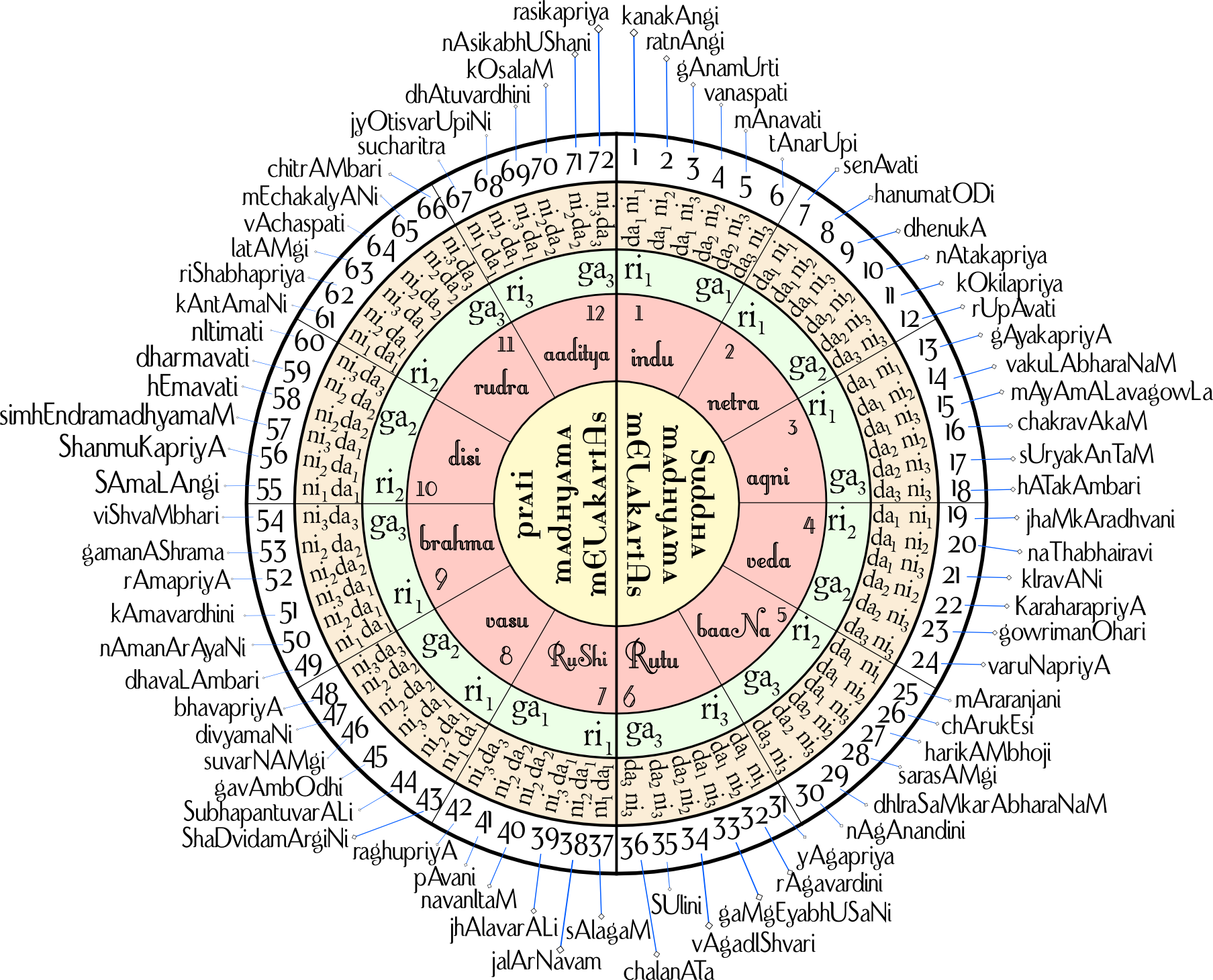
The 72 Melakarta system occupies a fundamental position in the theory and practice of Karṇāṭak music. The 72-Mēḷakarta system represents one of the most systematic theoretical histories of South Indian music. The seventy-two parent rāga-s are organised into twelve cakra-s, each containing six Mēḷakarta-s. The first six cakra-s employ śuddha madhyama, while the remaining six employ prati-madhyama. The systematic organization of the svara-sthāna-s creates a comprehensive framework within which parent rāga-s and their derivative janya rāga-s can be understood.
However, a purely theoretical classification alone does not create a musical identity. A Mēḷakarta becomes musically meaningful when the svara-s of a Mēḷakarta are transformed into characteristic prayōga-s, embellished with gamakas and organised within a tala structure manifest as distinctive musical expressions in compositions. The history of compositions in all seventy-two Mēḷakarta-s, therefore, provides an important field for examining the transition from lakṣaṇa to lakṣya.
The 72-Mēḷakarta System: From Classification to Musical Practice
The Mēḷakarta system provides a systematic organisation of parent rāga-s on the basis of seven svara-s in ascending and descending order. The scheme is divided into twelve cakra-s, with six mēḷa-s in each cakra. The first six cakra-s employ śuddha madhyama and the latter six prati-madhyama.
The value of the system is not restricted to memorising seventy-two names. It provides a structural framework for understanding the relationship between svara organisation and rāga formation. Knowledge of the Mēḷakarta system enables music learners and performers to identify the parent rāga associated with many janya rāga-s and to understand their basic svara relationships.
At the same time, a Mēḷakarta scale should not be confused with the complete musical personality of a rāga. A scale consists of the svara-sthāna-s; rāga identity emerges through the manner in which those svara-s are employed. Characteristic sañcāra-s, prayōga-s, nyāsa-s, gamaka-s, musical settings transform an abstract scale into a musically recognisable rāga.
This distinction is particularly important in the case of the Vivādi Mēḷa-s. Their theoretical completeness does not provide the practical understanding of the rāga. Thus, their significance can be more fully appreciated through the compositions that embody their melodic possibilities.
Two Nomenclatures of the 72 Mēḷa System
An important historical dimension of the Mēḷakarta tradition is the existence of two nomenclatures.
The earlier Kanakāmbari–Phēnadyuti nomenclature is associated with the Venkaṭamakhin/Muddu Venkaṭamakhin textual tradition and was followed by the Dīkṣitar paramparā[1]. The later Kanakāṅgi–Ratnāṅgi nomenclature is associated with Govindācārya’s Saṅgraha Cūḍāmaṇi and became the dominant nomenclature in the Tyāgarāja tradition and subsequently in mainstream Karṇāṭak pedagogy.
Muttusvāmi Dīkṣitar’s compositions are therefore frequently identified according to the Kanakāmbari–Phēnadyuti nomenclature. For example, what is generally called Kanakāṅgi today occurs in the Dīkṣitar tradition as Kanakāmbari, while Ratnāṅgi is Phēnadyuti. His compositions in rāga-s such as Gānasāmavarāli and Bhānumati provide important evidence for the application of this nomenclature in actual musical practice.
Tyāgarāja, by contrast, generally belongs to the later Kanakāṅgi–Ratnāṅgi nomenclatural tradition. Śyāma Śāstri’s repertoire represents a more limited compositions with the complete seventy-two system and should not be presented as an attempt to cover all seventy-two Mēḷa-s.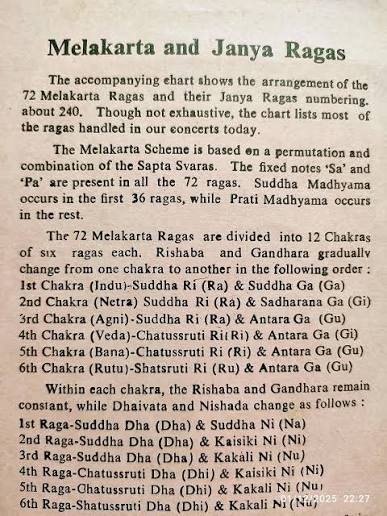
The distinction is not merely terminological. It reflects two historical streams of theoretical and musical transmission and illustrates how nomenclature, rāga identity and compositional practice interacted in the nineteenth-century Karṇāṭak tradition
The Trinity and the Mēḷakarta Tradition
Muttusvāmi Dīkṣitar occupies a particularly important place in the history of Mēḷakarta compositions because of his adherence to the Dīkṣitar school’s nomenclature and its corresponding rāga-lakṣaṇa tradition.
His compositions provide valuable musical evidence for several Mēḷakartās under the Kanakāmbari–Phēnadyuti system. The importance of his contribution lies not only in the number of Mēḷa-s represented but also in the manner in which he transformed theoretical rāga categories into musically distinctive compositions.
His treatment demonstrates that a Mēḷakarta identity is not exhausted by its scalar structure. The melodic movement, characteristic phrases and gamaka treatment employed in individual compositions contribute to the understanding of rāga-bhāva.
Tyāgarāja’s contribution to the Mēḷakarta repertoire was considerably broader. Although he did not compose in all seventy-two Mēḷa-s, his compositions in numerous parent rāga-s demonstrate how a theoretically defined scale could acquire a distinctive musical identity. He composed kṛti-s in nearly 40 mēḷakarta rāga-s. His compositions demonstrate how the janaka rāga could be transformed into musically expressive rāga-s through characteristic prayōga-s, gamaka-s and saṅgati.-s. Thus, Tyāgarāja’s contribution is significant not merely in terms of the number of mēḷakarta-s represented, but also in the manner in which he gave them a distinct musical identity through his compositions.
Śyāma Śāstri did not attempt the comprehensive coverage of the seventy-two Mēḷa-s. His importance lies instead in the depth of his treatment of selected rāga-s. His compositions in Tōḍi, Śaṅkarābharaṇa, Varāḷi and Kalyāṇi illustrate the way in which a composer could develop a strong rāga identity through a limited number of compositions.
The aspiration to represent all seventy-two Mēḷakarta-s in a single work or a systematic cycle predates the modern period.
Musical Compositions in 72 Mēḷakarta-s
The tradition of composing in all 72 Mēḷakarta-s represents a significant and challenging contribution to Karṇāṭak music. It demonstrates the musical possibilities of not only the widely performed Mēḷa-s but also the 40 Vivādi Mēḷa-s, which have received comparatively less attention. Over the years, several distinguished composers made remarkable contributions to the practical understanding and popularization of the 72 melakarta system. Among them, Maha Vaidyanatha Sivan, Koteeswara Iyer and Dr. M. Balamuralikrishna occupy particularly important positions.
Early Attempts at Comprehensive Coverage
Lavani Venkata Rao[2], traditionally associated with the Tanjavur Maratha court, is credited with a Marathi 72-Mēḷa rāgamālika, generally referred to as Bāhattara Mēḷa Rāgamālika. The work is associated with the court of Sakharam Saheb. The historical connection between this work and Mahā Vaidyanātha Śivan is documented in accounts preserved by the Music Academy.
The significance of such a work lies in its attempt to bring the entire Mēḷakarta system into a single musical composition. Composed in Marathi, this composition integrates all 72 mēḷakarta rāga-s following the structured Sampūrṇa Mēḷa framework.
Mahā Vaidyanātha Śivan and the 72-Mēḷa Rāgamālika
Mahā Vaidyanātha Śivan (1844–1893) represents a decisive stage in the practical history of the Mēḷakarta scheme. He made one of the most remarkable contributions to the 72-melakarta tradition through his celebrated 72 Mela Rāgamālika, beginning with the words “Praṇathārthihara Prabhō Purāre.” The composition is in praise of Lord Praṇathārhihara of Tiruvaiyaru and encompasses all 72 melakarta-s.
His celebrated Sanskrit 72-Mēḷa Rāgamālika, beginning with “Praṇatārthihara Prabhō Purāre,” brings all seventy-two Mēḷakarta-s into a single extended composition. The work is associated with Lord Praṇatārthihara of Tiruvaiyāru.
The traditional account connects the origin of this work with the court of Sakharam Saheb, associated with the Maratha court of Tanjore. A Marathi manuscript containing a 72-mēḷa rāgamālika by the court poet Venkata Rao was brought to the attention of the court. Maha Vaidyanatha Sivan set it to music and performed it before the ruler. Dissatisfied with its character as mere praise of the ruler, he subsequently created his own Sanskrit version in praise of Lord Pranatharthihara at Tiruvaiyaru.
It represents a major milestone in the history of melakarta compositions by combining all 72 mēḷa rāga-s into an integrated musical structure and demonstrating their distinctive lakṣaṇa through actual musical phrases.
This Rāgamālika begins with the words “Pranathārthihara” in the auspicious Rāga Śrī. The opening two lines may be regarded as the Pallavi, while the sahitya beginning with “Pramami” and ending with “Pate Pate” may be treated as the Anupallavi. The Anupallavi is followed by a jati in Rāga Śrī, and the composition is structured into six cakra-s. After every two cakra-s, the return to the melodic motif of Rāga Śrī provides a refreshing contrast, offering relief from the monotony that might otherwise result from the predictable succession of melodic patterns associated with the different Mēḷa-s.
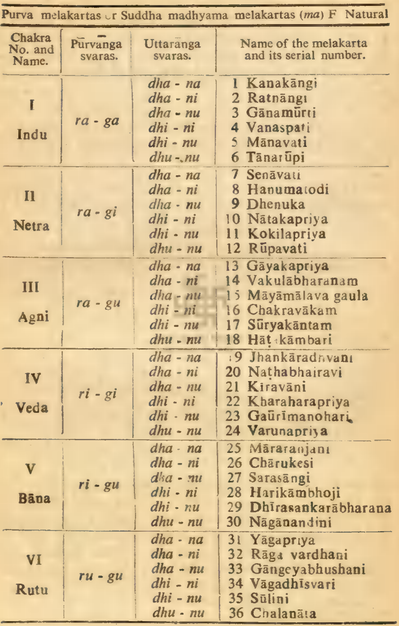
Another distinctive feature of this composition is the use of the ciṭṭasvara of the preceding rāga as a transitional device leading into the succeeding rāga. This technique creates a seamless connection between the different rāga-s. Interestingly, saṅgati-s are absent in all the rāgas except Kanakāṅgi, Ratnāṅgi, and Vanaspati.
His special feature is the way he has incorporated the rāga mudra beautifully for all the rāgas. For example, the name of the rāga Chalanãṭṭai is beautifully incorporated in the lines as
कैलासाचलनाटनकृभजु शलै दण्डकचरणागठु ॥ ३६ ॥
kailãsācalanāṭana kṛbhaju ṣaila daṇḍakacaraṇāgaṭhu || 36 |[3]|
The work is a lakṣya–lakṣaṇa prabandha: it demonstrates the musical phrases of the melakarta-s while simultaneously embodying the theoretical organization of the 72-rāga system.
Koṭīśvara Iyer: Seventy-Two Individual Kṛti-s
Koṭīśvara Iyer (c. 1870–1936) occupies a unique position in the history of Tamil Mēḷakarta compositions. A grandson of Kavi Kunjara Bhārati, he received musical training from distinguished musicians including Poochi Srinivasa Iyengar and Patnam Subramania Iyer. He adopted the mudrā “Kavi Kunjara Dāsan” in honour of his grandfather.
His major contribution is Kanda Gānamudam, a collection of seventy-two individual compositions, one in each Mēḷakarta rāga. The work therefore differs fundamentally from Mahā Vaidyanātha Śivan’s rāgamālika.
Koṭīśvara Iyer beautifully incorporated the raga mudra in the sāhitya. For instance, the sāhitya of Dhēnuka mēḷarāga kṛti is illustrated here:
மருகா குகனே தினம் ஓதன மோடருள் மாதனமே
திருமாமயிலை அறுமாமுகனே
கன காம தேனுகா வென இனுமே
கவி குஞ்சர தாஸனுக் கிருள் நலமே[4]
His treatment of the vivādi mēḷakarta-s is particularly significant. His Kanda Gānamudam therefore became an important practical resource for us.
Kavi Yogi Śuddhānanda Bhārati and Mēlārṇavam
Kavi Yogi Śuddhānanda Bhārati (1897–1990) extended the tradition of systematic Mēḷakarta composition through Śuddhānanda Mēlārṇavam, a collection containing compositions in all seventy-two Mēḷakarta rāga-s.
The work represents an important development because it brings the complete Mēḷakarta system into Tamil devotional and philosophical expression. The treatment of the Vivādi Mēḷa-s and the incorporation of rāga mudrā into the sāhitya deserve further analytical study.
His kṛti-s gained wider recognition through the performances of eminent musicians such as N. C. Vasanthakokilam, M. S. Subbulakshmi, D. K. Pattammal and M. L. Vasanthakumari, who helped bring several of these compositions into the concert repertoire.
- Pattammal and the Tamil Mēḷakarta Tradition
- Pattammal’s contribution represents an important dimension in the history of women composers and Tamil composition. She is particularly noteworthy as one of the earliest women composers to undertake the systematic composition of kṛti-s in all the 72 melakarta rāga-s in Tamil.
Following the precedent established by Koṭīśvara Iyer, she composed kṛti-s in all seventy-two Mēḷakarta rāga-s in Tamil and compiled them under the title Mēlarāga Kṛti Māla.
The Vivādi Mēḷa compositions are especially worthy of study. A study of her vivādi melakarta kṛti-s reveals a simple compositional style. The compositions generally avoid an excessive number of saṅgati-s and retain a clear melodic structure. Most of the kṛti-s follow the conventional format of pallavi, anupallavi and caraṇam, with the pallavi and anupallavi generally occupying about two to four āvartana-s, while the caraṇam extends to approximately four to six āvartana-s.
Another noteworthy feature of some of her compositions is the skilful use of prāsa. For example, in the Dhātu-vardhani kriti “Pādāmbhujam Dhūnayena”, different forms of poetic ornamentation, including anuprāsa, dvitīyākṣara prāsa and antyaprāsa, are employed. The integration of these literary aspects demonstrates the composer’s attention to both the musical and poetic dimensions of the kriti.
Her Mēlarāga Kṛti Māla deserves consideration not merely as a numerical completion of the seventy-two Mēḷa-s but recognition as an important contribution to the development of Tamil kṛti-s in all the 72 melakarta rāga-s, particularly for its simplicity and systematic approach.
Balamuralikrishna and Janaka Rāga Kṛti Mañjari
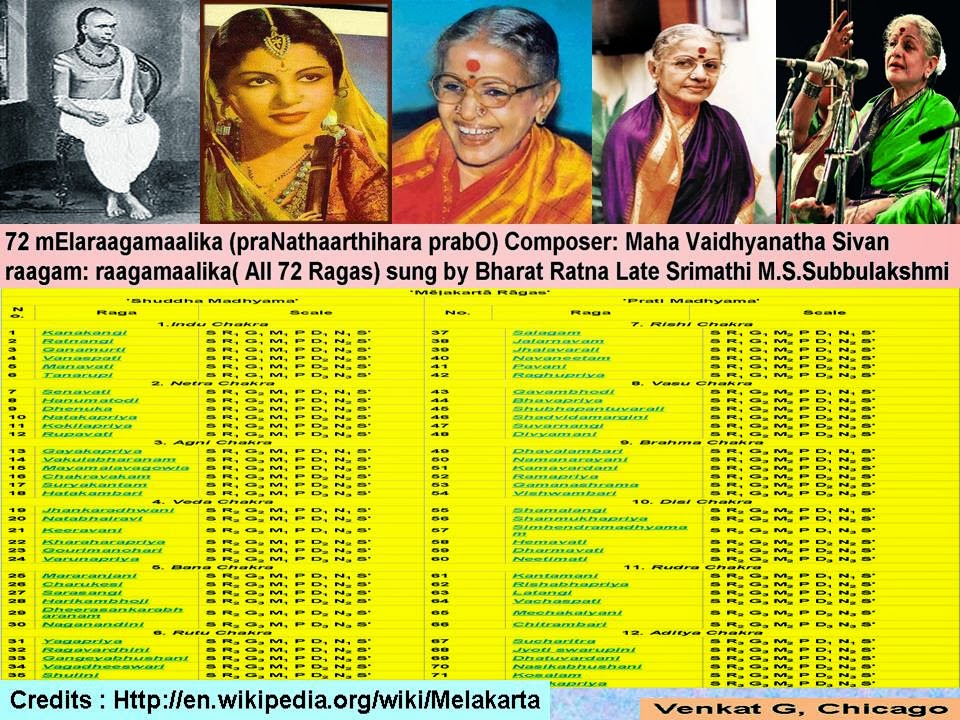
Dr. Mangalampalli Balamuralikrishna (1930–2016) was one of the most versatile musicians and composers of modern Karṇāṭak music. He represents as one of the most distinctive modern composers with the seventy-two Mēḷakarta system.
His Janaka Rāga Kṛti Mañjari consists of seventy-two kṛti-s in the seventy-two Mēḷakarta rāga-s. Documentary accounts of the work note that Balamuralikrishna began this ambitious project in his youth and completed it before reaching adulthood.
The significance of this collection lies particularly in its attention to melodic characterization. The challenge of composing in seventy-two Mēḷa-s is not simply to reproduce their scalar sequences. The greater challenge is to ensure that each composition possesses a recognizable melodic identity.
Most kṛti-s have the angas Pallavi, Anupallavi, and Saranam. Some kṛti-s have only Pallavi and Anupallavi.In the Vivādi Mēḷa compositions, the use of prosodical beauties such as anuprāsa, dvitīyākṣara prāsa and antyaprāsa, together with svarākṣara and gamakas, provides a meaningful link between the sāhitya and the expression of rāga bhava.
To illustrate, the kṛti set in rāga Navanītam, commencing with the phrase “Himātmaje,” incorporates a distinctive ciṭṭa-svara segment. Similarly, within the Jaṅgāradhvani composition “Jāśakedhana Pīṭham,” the sāhitya for every aṅga is structured to begin with the specific syllable “Ja,” demonstrating a conscious application of phonetic ornamentation.
Cuddalore Subramaniam (1920-2020)
Cuddalore Subramaniam is yet another composer associated with compositions in all 72 melakarta rāga-s. In order to achieve his ambition of serving the students of music and musicians of all languages and help to render the compositions perfectly, the script of the 72 Meḷakartā Rāga Krtis are in Devanagari and also in English & Tamil. He has dedicated his compositions to Sri. ‘Pātalīśwarar’ and Sri. ‘Brihannāyaki’, the presiding deity of his place of birth, Cuddalore, whose divine blessings have made him a musician and composer. The word ‘PĀTALĪŚA’ is the Mudra (stamp) for all his compositions. His kṛti-s also incorporate the mēla mudra, making the identity of the parent rāga explicit within the sāhitya.
In 1982 he published ‘Kritis in 72 Melakartha Ragams’, ‘Varnams’, ‘Keerthanas in Apoorva ragas’ and ‘Sri. Raja Rajeshwari Pancharathnam’, released by the then Tamil Nadu Governor (1982-1988) Sri. S.L. Khurana.
In 1993, he recorded the 72 Melakartā raga kritis, composed and sung by him, with vocal support by (late) Sri. M.S. Sai Prasad.
Yāzhpāṇam Vịramaṇi Iyer and 72 Meḷakartha Rāga Tirumayilai Karpakāmbal Kīrthanaikaḷ
He was the grandson of the famous Koṭīśvara Iyer. He also composed kṛti-s on Mayilai Karpakambal in 72 Melakartha ragas and compiled them into a book called “72 Melakartha rāga Thirumayilai Karpakambal Kirthanaikal”[5]. Compared with Koṭīśvara Iyer, his kṛti-s have received less popular recognition.
In the Vivadi Melak kṛti-s , we find fewer Sangatis. In most of the kṛti-s , he has used Svarakashara and Spurita gamakas. The three words “Karpakam, Mayilai, Kapali” are included in all the kṛti-s along with the Raga Mudra.
The Mysore Court and the 72-Mēḷa Challenge
The history of the seventy-two Mēḷakarta compositions also intersects with the cultural history of the Mysore court.
A traditional account relates that the celebrated nāgasvara vidvan Madurai Ponnuswamy Pillai expressed the view that only a portion of the seventy-two Mēḷa-s were suitable for musical composition and that the forty Vivādi Mēḷa-s were not practically viable.
According to this account, Nalvadi Krishnaraja Wodeyar, himself deeply interested in music, challenged the court musicians to demonstrate the musical viability of the complete seventy-two system by composing in all seventy-two Mēḷa-s. The documentary evidence associated with the Mysore Palace Archives is particularly valuable.
Belakavadi Srinivasa Iyengar (1888–1936) is reported to have completed compositions in all seventy-two Mēḷa-s. A letter dated 5 April 1927 from the Darbar Bakshi is cited as documentary confirmation of the achievement and records his performance before the Maharaja. In recognition of this achievement, Srinivasa Iyengar was honoured with the opportunity to perform these kṛti-s on the violin before the Maharaja
According to records in the same archives, Vidwan Sikkarama Rao (1891–1945), a musician in the Mysore court, composed kṛti-s in all 40 Vivādi Mēḷas and in 30 of the remaining 32 Mēḷakartas. Unfortunately, these compositions are believed to have remained with his descendants or within his disciple lineage and are not presently available.
Vīṇā Śivaramayya (1886–1946) also composed and performed kṛti-s in all 72 Mēḷakartas in the presence of the Maharaja. He carefully notated and preserved the compositions before presenting them to the king. As a result, his kṛti-s survived through his disciple lineage and have been transmitted to the present day.
After composing the kriti “Dinamani Sayapate” in Rāga Rasikapriya, he recorded in Kannada that, in accordance with the command of Nalvadi Krishnaraja Wodeyar, he had composed kṛti-s in all 72 Mēḷakartas and submitted them to the Maharaja.
These records are particularly important because they move the discussion beyond anecdotal history. Many other composers composed kṛti-s in the 72 Melakartha ragas as per the king’s orders. However, those kṛti-s perished along with the glory of Krishnaraja Wodeyar’s empire.
Later and Contemporary Extensions
The tradition did not end with the early twentieth-century composers. A number of later composers continued to compose compositions in the complete Mēḷakarta system.
Among the names associated with this continuing tradition are R. K. Suryanarayana, C. Rangaiah, Kalyani Varadarajan and Ashok R. Madhav.
Vidwan Shri R K Suryanarayana[6] or Rudrapatnam Keshavamurthy Suryanarayana or simply RKS (Born 14 June 1937 – Died 24 December 2003). Renowned veena exponent and composer who contributed extensively to rare and primary melakarta compositions.
- Rangaiah[7] -(1895–1984) was a renowned composer, musicologist, and teacher from Mysore. A senior contemporary of T. Chowdaiah, learned under eminent masters including Mysore Vasudevacharya and Veena Shivaramaiah. He used the mudra “Ranga” in his works.
Kalyani Varadarajan[8] (8 October 1923 – 28 October 2003), commonly known as Kalyani, was one of famous twentieth-century composers.
She composed compositions in all seventy-two Mēḷakarta rāga-s in addition to numerous janya rāga-s.
Dr. Ashok Madhav is a well known composer, residing in the United States. He has composed several Kritis, Varnas, thillanas, which is in use by other composers. He has developed “72 melakarta” compositions in South Indian languages. Noted contemporary composer known for the monumental collection Melakartha Ganamalika, featuring pieces in all 72 melakarta ragas across multiple South Indian languages.
These composers represent the continuation of the tradition of exploring the entire 72-Mēḷakarta system, including the Vivādi Mēḷas, through original compositions. It represents a continuing compositional challenge undertaken by successive generations.
Conclusion
The history of compositions in all seventy-two Mēḷakarta rāga-s represents one of the most remarkable continuing traditions in Karṇāṭak music.
Mahā Vaidyanātha Śivan demonstrated that all seventy-two Mēḷa-s could be organized within a single monumental rāgamālika. Koṭīśvara Iyer demonstrated that each Mēḷakarta could sustain an independent Tamil kṛti. Śuddhānanda Bhārati extended the tradition through Tamil devotional and literary expression. D. Pattammal contributed a systematic corpus of Tamil compositions representing all seventy-two Mēḷa-s. Balamuralikrishna presented the melakarta-s through Rāgāṅga Rāvalli. The Mysore composers preserved through courtly performance, notation and archival transmission. Later composers continued this process, demonstrating that the tradition remains open-ended.
Analyzing these compositions enables a deeper understanding of rāga-bhāva and gamaka, providing vital insights into the distinctive svara-prayōga-s that define the seventy-two mēḷakarta rāga-s.
References
[1]Subbarāma Dīkṣitar, “Saṅgīta Sampradāya Pradarśini of Subbarāma Dīkṣitar, Tamiz Script Edition, The Music Academy, Madras, vol.1, 1963.
.[2] P. P. Narayanaswami, Mēḷa Rāgamālika ofMahā Vaidyanātha Iyer Text in Sanskrit and English With line-by-lineMeaning and Notations (including with Notations),April 2024;pg-2
[3] P. P. Narayanaswami, Mēḷa Rāgamālika ofMahā Vaidyanātha Iyer Text in Sanskrit and English With line-by-lineMeaning and Notations (including with Notations), April 2024: pg -59
[4] Kotisvara Aiyar, N, Kanda Ganamudam, Part-1, 1932, The Madras Law journal press, Mylapore, Madras. Pg:29.
[5] Viramani Ayyar, Ma Ta Na, 72 Melakartta Ragat Tirumayilai Karpagambal Kirttanigal, 2000
[6] https://www.facebook.com/uniquemusicworld2021/posts/remembering-vidwan-shri-r-k-suryanarayana-or-rudrapatnam-keshavamurthy-suryanara/1437680995053855/
[7] https://www.carnaticcorner.com/articles/composers-from-karnataka.htm
[8] https://en.wikipedia.org/wiki/Kalyani_Varadarajan
Bibliography
- Subbarāma Dīkṣitar, “Saṅgīta Sampradāya Pradarśini of Subbarāma Dīkṣitar, Tamiz Script Edition, The Music Academy, Madras, vol.1, 1963.
” Srinivasan, M S, Vaiyaccēri Mahā Vaidyanātha Sivanum Rāmasvāmi Sivanum Iyaṟṟiya Sila Pāḍalgaḷ, 2001,
Kotisvara Aiyar, N, Kanda Ganamudam, Part-1, 1932, The Madras Law journal press, Mylapore, Madras.
Kotisvara Aiyar, N, Kanda Ganamudam, Part-2, 1938, The Madras Law journal press, Mylapore, Madras.
https://musicresearchlibrary.net/omeka/items/show/3209.
Raghavan T S, Suddhananda Melarnavam of Suddhananda Bharati, 1981
https://musicresearchlibrary.net/omeka/items/show/1605
Pattammal, D, Mela Raga Krithi Mala,
https://www.dpattammal.com/mela-raga-kiruthi-mala.htm
Balamuralikrishna M, Janakaraga Krti Manjari, 1952.
https://musicresearchlibrary.net/omeka/items/show/3110
Subramaniam, Cuddalore M, Kritis in 72 Melakarthas, 1982
https://www.cuddaloremsubramaniam.com/books.php
Viramani Ayyar, Ma Ta Na, 72 Melakartta Ragat Tirumayilai Karpagambal Kirttanigal, 2000.
https://musicresearchlibrary.net/omeka/items/show/2103
https://www.carnaticcorner.com/articles/composers-from-Karṇāṭaka.htm
https://www.carnaticcorner.com/articles/ashokmadhav_compositions.htm
https://en.wikipedia.org/wiki/Kalyani_Varadarajan
Few words about Author
Dr. K. Rukmani is an accomplished Carnatic vocalist, academician, and All India Radio graded artist with over two decades of experience. She serves as Principal (i/c) and Associate Professor of Music at Sri Sathguru Sangeetha Vidyalayam, Madurai. Trained under gurus including Smt. Ambujam Vedantham and Smt. Suguna Varadachari, she holds an M.A. and Ph.D. in Music and is a recognized Ph.D. research guide. A recipient of the ‘Sangeetha Kalanidhi’ award (Madurai Vedic Centre, 2017), her research spans Tamil music, sahitya, composer studies, and interdisciplinary literary-musical connections.