Melodies of Devotion : The Changing Role of Indian Classical Music in Durga Puja
BRINTALI ACHARYA
RESEARCH SCHOLAR, TRIPURA UNIVERSITY
Abstract
Durga Puja is one of the most significant religious and cultural celebrations in Bengal, encompassing elements like worship, music, sculpture, architecture, literature, performance and community participation. Although the festival’s visual splendor and religious ceremonies are well known. The relationship between Indian classical music and Durga Puja offers fresh perspectives for academic study. This article, titled “Melodies of Devotion: The Changing Role of Indian Classical Music in Durga Puja ” examines the connection between Hindustani classical music, Bengali devotional traditions, the evolving social context of the festival, particularly in Kolkata. The article explores the cultural importance of musical accompaniment, the development of classical music in colonial Calcutta, the role of aristocratic family celebrations, the growth of public Durga Puja events and the impact of modern audio technology on musical performances.
The study differentiates between Hindustani classical music forms, such as dhrupad, khayal, instrumental music and other musical traditions like Shyamasangeet, Rabindrasangeet, kirtan, ritual drumming and various other styles linked to Bengali religious and cultural practices. Even though these traditions influence each other, they are not the same. The article suggests that the connection between classical music and the festival of Durga Puja should be viewed as an evolving cultural process, rather than a straightforward story of decline from a perfect past. The shift from small family events to big public celebrations has changed how music is supported, where it is performed, how people listen to it and how audiences engage. Modern technology presents new ways to share music but commercial influences and other forms of entertainment can make it harder for people to keep listening to classical music consistently.
Drawing from research in musicology, colonial history, religious studies and cultural heritage, along with institutional records related to Durga Puja, this article presents a framework for viewing classical music as an integral part of Bengal’s ongoing cultural heritage. It also highlights the importance of conducting archival research, collecting oral histories and documenting specific examples of household and community pujas. The article ends by stating that the survival of classical music within Durga Puja relies on preserving its history, offering fair support to performers, organizing relevant public events and creating opportunities for audiences to deeply experience the richness of classical music.
Keywords : Durga Puja, Indian classical music, Hindustani music, Shakta music, Agamani songs, Shyama Sangeet, Rabindra sangeet, Devotional music, cultural heritage.
- Introduction
Durga Puja is much more than a yearly religious festival
In Bengal, especially in Kolkata, it is a cultural celebration where religious faith, artistic expression, family traditions and public joy merge. The festival pays tribute to the goddess Durga and marks her victory over the buffalo demon Mahishasura, symbolizing the triumph of divine strength over destructive powers. This spiritual significance is reflected through rituals, worship, sacred depictions, chanting, offerings, music and community involvement.
The cultural value of Durga Puja goes beyond its religious practices. Artists create the images of the goddess, artisans design elaborate decorations, musicians enhance the festival’s atmosphere with their performances and communities come together to hold ceremonies and public events. Throughout the city, streets and local areas turn into vibrant cultural spaces where visual and sound experiences blend seamlessly.
The importance of this cultural setting gained worldwide attention when UNESCO added Durga Puja in Kolkata to the Representative List of the Intangible Cultural Heritage of Humanity in 2021. UNESCO highlights how the festival blends religious activities, artistic teamwork, traditional Bengali drumming and community involvement. The recognition acknowledges the role of families, puja committees, priests, drummers, artists and craftspeople in keeping the festival alive as a continuing cultural tradition (UNESCO 2021). This structure is beneficial for music research because it promotes looking at music within the context of wider cultural activities.
The sounds associated with Durga Puja consist of dhak, conch shells, bells, devotional singing, instrumental music and recorded verious compositions. Each of these elements plays a unique role in the festival. Ritualistic percussion might be used during specific ceremonial events, while devotional songs express religious emotions. When classical music is performed, it can offer a focused listening experience or serve as part of a broader cultural performance program.
These differences are crucial to understanding the role of Indian classical music in the history of Durga Puja. Just because music is present during a festival does not mean it is part of the religious rituals. A classical music performance in a home courtyard, a devotional song sung before the goddess and a recording played through public speakers each serve different purposes, even when they take place during the same celebration.
Defining Indian classical music
Indian classical music refers to a wide range of musical traditions, with the most notable ones being Hindustani music in the northern and eastern parts of India and Carnatic music in the southern regions.
This article primarily focuses on Hindustani classical music due to its historical importance in Kolkata and Bengal. Hindustani music is based on key ideas like raga and tala. A raga serves as a melodic structure, defining specific note sequences, melodic progressions and expressive elements. Tala, on the other hand, deals with rhythmic patterns and provides a framework for the coordination between musicians. Using these structures, performers create compositions and engage in spontaneous improvisations, which allow for personal artistic expression.
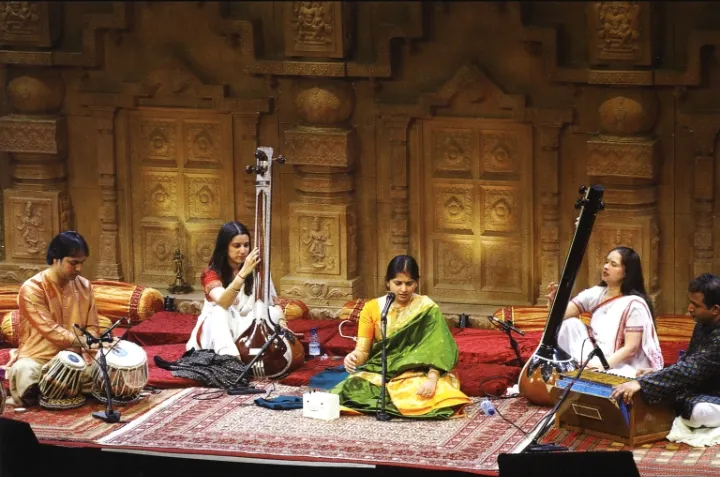
Dhrupad, khayal and instrumental forms are key aspects of Hindustani classical music that are essential for understanding its structure and development. Dhrupad is linked with structured compositions and the continuous exploration of melodies. Khayal offers greater freedom for improvisation and intricate melodic variations. Dance and Instrumental music, performed on classical and other songs with instruments such as the sitar, sarod, flute, violin, esraj and others, further enriches the exploration of ragas and rhythmic patterns. Thumri holds a significant place within the wider framework of Hindustani music and is often considered a semi-classical form.
It is known for its emotional expression through poetic lyrics, elaborate ornamentation and subtle emotional interpretation, which can link musical performance with spiritual or devotional meaning. It is important not to equate Indian classical music with all the musical forms connected to Durga Puja. Forms like Shyamasangeet, Rabindra sangeet, kirtan, Shakta – devotional songs and ritual percussion have their own unique histories and traditions. While they may share some elements with classical music, they are not automatically classified as Hindustani classical.
This distinction is crucial because the musical culture of Bengal is shaped by interactions between different styles, languages, religious practices and performance environments. When examining classical music within the context of Durga Puja, it is necessary to recognize these interconnections without disregarding the differences that exist between them.
The historical significance of Kolkata
Kolkata holds a significant position in the history of Indian classical music. During the colonial era, the city became a major hub for musical performances, publishing and intellectual conversations. The movement of musicians from various regions, the growth of urban cultural organizations and the spread of musical writings helped shape its musical atmosphere. Richard David Williams’s research on Bengali musicological writings between 1818 and 1905 ( Articles – Music, Lyrics and the Bengali book: Hindustani Musicology in Calcutta) shows that Hindustani music was widely published in 19th-century Bengal. Bengali writers created theoretical works, historical analyses and song compilations, which helped spread and shape the understanding of musical knowledge (Williams 2016). The musical development in colonial Bengal was not confined to one social class or organization. It involved performers, scholars, supporters, composers, teachers and audience members. Music was passed on through personal teaching and live performances but it was also explored in books and shared through printed collections.
This wider background is important for understanding the link between classical music and Durga Puja. It shows that the festival evolved in a city with a growing and complex musical culture. However, the presence of a vibrant classical music scene in Calcutta does not mean that classical concerts were held at every home during the festival. The exact connection needs to be supported by evidence from specific households, historical records, concert programs, personal accounts or archival sources.
Objectives
The main goal of this article is to explore the evolving role of Indian classical music in the context of Durga Puja. It attempts to resolve the following questions: In what way did classical music become integrated into the cultural fabric of Kolkata and what part did aristocratic families, other supporters play in promoting musical performances? How did classical music coexist with devotional songs and ritual sounds during Durga Puja and how did the expansion of public, community-led celebrations influence the chances for musical performance, audience engagement?
- What impact have microphones, recordings, digital media and modern festival arrangements had on the practice of classical music? How can classical music be maintained and effectively showcased in the ever-changing cultural setting of Durga Puja? The article is an interdisciplinary approach, integrating historical musicology, cultural history, religious studies and performance analysis. It draws on published scholarship about Indian classical music and colonial Bengal, as well as institutional records related to Durga Puja. It is important to interpret the evidence with care. Any claims regarding a specific vocalist, raga or instrumental performance at a particular household puja must be supported by reliable evidence. A more detailed study would benefit from archival research in Bengali newspapers, family records, memoirs, concert programmes, photographs and musical recordings. Conducting interviews with musicians, organizers of household events, cultural programme coordinators and descendants of families connected to historical celebrations could also uncover practices that are not yet documented.
- The Historical Background of Music and Durga Puja
The history of Durga Puja in Kolkata is closely linked with the evolution of the city’s social structure. Celebrations arranged by influential families became significant events for religious practices, hospitality and public acknowledgment. The traditional “bonedi bari puja” continues to be connected with inherited customs, family legacies and unique architectural settings. The thakurdalan, which is the courtyard or hall used for household worship, provides a valuable insight into the connection between ritual and performance. These spaces allowed for worship, family gatherings and social interactions. The layout of these areas influenced how participants experienced ceremonies and how sound moved within the home. It is important to highlight the variety in household practices. Not all families had the same resources, invited the same performers or arranged the same programmes. The historical importance of the bonedi bari should not be used as evidence that classical music was always performed at these events. A trustworthy history must identify particular households and document their musical activities through specific records.
Patronage and the development of musical culture
Patronage has played a significant role in shaping various classical music traditions. Musicians need time to practice, chances to perform and financial assistance to keep their artistic work going. People who support musicians may do so out of personal interest, admiration for the art, religious beliefs or the social status that comes from welcoming skilled performers.
In colonial Calcutta, the relationships between patrons and musicians were part of a broader cultural setting. Performers moved between different centers of patronage, built professional connections and met audiences with varying musical tastes.
Richard David Williams’s subsequent studies on the movement of Hindustani musicians and the changing musical environment in colonial Bengal offer additional insight into this context. His work, “The Scattered Court : Hindustani Music in Colonial bengal” published 2023, explores how musicians and artistic traditions flowed between northern India and Bengal, especially in connection with the exile of Wajid Ali Shah in Calcutta’s Matiaburj (Williams 2023).This academic work helps explain why Kolkata became a key center for Hindustani musical culture.
From private worship to community celebration
The shift from individual household celebrations to public collective worship was one of the most important changes in the social history of Durga Puja. The later growth of sarbojanin pujas made collective involvement more central to the festival. This change altered the way festival culture was organized socially. Music, which was once heard in a limited social setting, began to be performed for wider community audiences. Organizers of community events had to think about how to make their events accessible, consider the shared interests of the group, manage available resources and ensure the logistics of large gatherings worked smoothly. Public participation also broadened the musical atmosphere of the festival. Although ritual drumming and devotional singing remained important, community celebrations began to include theatrical performances, group singing, instrumental groups and eventually amplified entertainment. The role of classical music within this evolving structure varied depending on local conditions.
Understanding Indian Classical Music in the Context of Durga Puja
The principles of Hindustani classical music
Hindustani classical music is one of the main art-music traditions in India. The main features of this tradition involve raga, tala, improvisation, melodic progression and the relationship between a performer and an experienced audience. A raga is not simply a scale ; it is a structured melodic framework that includes specific phrases, melodic movements, decorative elements and expressive qualities. Tala is a system that organises musical time using repeating rhythmic patterns. Vocal forms such as khayal, dhrupad and thumri, as well as dance , instrumental traditions featuring instruments like the sitar, sarod, flute, violin have emerged within their own unique performance styles.
The development of these forms reflects the influence of regional traditions, support from royal courts, involvement of religious institutions, the continuity of hereditary musical families and the growth of modern concert culture. Classical musicians sometimes perform devotional pieces and devotional music often makes use of techniques based on raga. Despite this, a classical recital and a performance involving ritual drumming usually have different main purposes.
Classical music and devotional expression
Indian classical music has historically engaged with religious and devotional practices. The connection between music and spirituality can be shown through lyrics directed towards a deity, the use of sacred images, the performance of devotional pieces or the development of a strong emotional and aesthetic experience.
A classical singer might present a devotional song within a specific raga, allowing for musical embellishment that enhances the emotional depth of the words. Instrumental music can also create a thoughtful and reflective mood without the need for words. These performances can help listeners feel devotion through careful listening and appreciation of the music’s beauty.
Classical music as cultural prestige
Classical music has also been linked to education, artistic discipline and cultural recognition. In certain historical contexts, the ability to support or appreciate trained musicians could improve the reputation of a patron or institution. During the colonial period, musical culture in Bengal experienced changes in how it was supported, published and performed.
Musical knowledge started to spread more through printed materials, formal instruction, public concerts and institutions. The transformation of Durga Puja into a public cultural event provided opportunities for classical music to reach broader social settings. A musical performance could express devotion while also showing that a community valued artistic excellence. This dual role highlights the festival’s ability to combine religious and cultural goals within a single setting.
Raga, Tala and the Musical Imagination of the Goddess
Raga as an expressive framework
The connection between raga and devotional expression is best understood by looking at the expressive potential of melody rather than by adhering to a strict list of ragas that are supposedly used in Durga Puja rituals. In Indian musical traditions, different ragas are linked with specific emotional and aesthetic qualities, but these meanings are not fixed. The way a raga is interpreted can change based on the performance context, the lyrics, the tempo, the use of ornamentation and the listener’s cultural background. In devotional settings, a raga can influence the emotional tone of a song. The image of Durga encompasses various emotional aspects: maternal love, protection, bravery, cosmic power and the triumph over destructive forces. Musical expression can highlight any of these characteristics. A devotional singer might focus on the goddess’s gentle, nurturing side while a strong and rhythmic approach might reflect her strength as the conqueror of Mahishasura. Any specific historical claims about this need to be supported by evidence from musical manuscripts, notation, programme records, oral histories or contemporary accounts.
Tala and the experience of ritual time
Tala, which refers to the organisation of rhythmic cycles provide a framework for improvisation and interaction between melody and percussion. The listener learns to identify the return of a cycle and to appreciate how musical phrases relate to it. The dhak is especially important in the public soundscape of Bengali Durga Puja. Its forceful, distinctive rhythms announce ritual activity and generate a sense of collective excitement. The sound is immediately recognisable to many festival participants, including those who may not have formal musical training. It illustrates the coexistence of musical systems with different functions.
Listening, participation and devotion
Classical music generally requires forms of attentive listening that differ from the participation encouraged by communal singing and percussion. A concert audience may follow the gradual unfolding of a raga, appreciate subtle ornamentation or recognise the relationship between improvisation and rhythmic structure.
At a public puja, people move through various ritual areas, engage in social interactions, watch performances and view visual displays. Some stop to listen closely; others experience music as part of a wider atmosphere. This diversity of listening practices is a defining feature of the festival. It can create moments of concentrated listening within an otherwise bustling public celebration. At the same time, the festival provides classical performers with an opportunity to encounter audiences who might not regularly attend specialized concerts.
Shakta Devotion and the Musical Traditions of Bengal
Shakta Music and the Worship of the Goddess
Bengal has a long tradition of devotional music connected to the goddess. In Shakta traditions, the divine feminine is central and there are various ways people imagine their relationship with the deity. The goddess can be seen as a cosmic force, a protective mother, a beloved daughter or a close presence in daily life.
Music helps express these spiritual connections in a deeply emotional way. A song may speak directly to the goddess, describe her beauty, tell stories about her or show the devotion’s pain and hope. The personal tone of the lyrics often helps listeners connect religious ideas with their own lives. Shakta devotional music shares many features with classical music but is not the same. Some songs use raga-based melodies or are performed by singers trained in classical styles. Others come from local devotional, folk or popular traditions. While these forms are different, they often blend together. However, they should not be considered the same.
Agamani songs : welcoming the daughter
Agamani songs are among the most emotionally moving musical forms linked to Durga’s yearly visit to Bengal. The term refers to songs that express a welcome and their stories often portray the goddess returning to her maternal home after being away with Shiva. These songs bring mythological tales into the realm of personal, domestic feelings. Durga is depicted as a daughter and her mother eagerly awaits her return. While the goddess’s arrival is celebrated with happiness, the brevity of her visit adds a subtle tone of sadness. The emotional impact of Agamani songs is partly due to their relatability. Their lyrics draw on relationships that are familiar to listeners — such as between mothers and daughters, homes and travels, parting and reuniting. Through this everyday imagery, a divine event becomes a deeply personal human experience. Not all Agamani songs are classical in style. Their musical forms vary and some are closely tied to Bengali devotional and folk traditions. However, their melodic style can blend with classical music practices, especially through the use of ornamentation, expressive singing and the portrayal of emotional lyrics. Beyond their performance, Agamani songs also hold historical importance. They preserve ideas about family, gender, religious devotion and Bengali identity. They offer a musical way for generations to imagine and celebrate Durga’s arrival.
Bijoya Songs and the Sadness of Departure
Bijoya songs are connected to farewells and the emotional feelings that come after the goddess’s departure. While Agamani songs celebrate her arrival, Bijoya songs usually express the sorrow of separation. The difference in emotions between welcoming and saying goodbye gives the Durga Puja cycle a unique musical structure. Devotees start with expectation, move on to celebration and then feel the sadness of immersion. Music helps remember these changing emotions, turning a short religious event into a repeated emotional experience.This cycle also shows how religious time is connected to social memory. The goddess comes back each year but each goodbye happens in a specific historical and personal setting. Songs keep the emotional language alive, helping the community understand and feel the meaning of her return. From a musical point of view, the power of these songs is not just about how their melodies are classified. The sound of the voice, repeated lyrics, rhythm and the familiarity of the words all play a role in how they are received. Their importance comes from the connection between the music’s structure, its spiritual message and the shared participation of the community.
Shyama Sangeet and the intimate mother
Shyama Sangeet is a Bengali devotional tradition mainly linked to Kali, another significant form of the goddess. It is connected to the broader cultural setting of Durga Puja because Bengali devotion to the goddess often portrays her through the themes of motherhood, vulnerability, dependence and affection. The songs connected to Ramprasad Sen and Kamalakanta Bhattacharya developed a strong lyrical tradition in which the devotee speaks to the goddess as a mother. This mother can be loving, unpredictable, compassionate or even fearsome. These songs often blend deep philosophical thoughts with simple, emotional expressions.
Although Shyama Sangeet is not solely meant for Durga Puja, its devotional style helps us understand how Bengali culture relates to the divine feminine. Its greater significance is in showing how classical techniques and devotional appeal can support each other without losing their unique qualities.
Kirtan and collective singing
Kirtan is another significant aspect of Bengali devotional culture. While Bengali kirtan has historically been closely linked with Vaishnava devotion, its wider significance is found in how collective singing can bring people together in religious practice. Unlike a concert that mainly highlights an individual’s musical skill, participatory devotional singing invites the audience to join in a repeated phrase, respond to a lead singer or move together through musical patterns. These practices turn the act of singing into a shared experience. This form of participation provides a useful contrast with the different types of music seen during Durga Puja.
Classical music often focuses on the talents of a single performer, whereas collective devotional singing highlights shared expression. Neither style is more religious or culturally important than the other; each creates a different dynamic between performers and listeners. The spread of devotional music across different regions and religious groups also reminds us that Bengal’s musical culture cannot be viewed as separate and isolated. Musical ideas, performance methods and ways of supporting artists have always moved between different groups and institutions.
Colonial Bengal and the Transformation of Musical Culture
Calcutta as a centre of musical exchange
During the colonial period, the growth of Calcutta changed the environment for music performance, teaching, publishing, and assessment. The city drew in musicians and educators, promoted the printing and theatre industries, and became a hub where various musical traditions interacted. Hindustani classical music spread through courtly connections, professional musicians, private lessons, public performances and new urban institutions. Bengali patrons and intellectuals took part in discussions about musical theory, notation, performance and cultural identity. The increase in music publishing played a significant role. Printed treatises and song collections made musical knowledge accessible beyond the teacher-student relationship. They also encouraged new methods of classifying musical styles and recording repertoires.
Music, colonial modernity and cultural identity
Colonial modernity brought about new ways of public life, education, the spread of printed materials and cultural discussions. Music became a part of wider conversations about respectability, artistic quality, national identity, and the connection between traditional practices and modern institutions. In Bengal, the rise of an educated middle class led to new ways of engaging with music. Music could be considered a disciplined art form, a means of expressing devotion, a part of literary culture, or a symbol of regional identity.
Durga Puja took place within these changing circumstances. Private celebrations still reflected family histories and the support of patrons while public festivities began to link religious practices with shared cultural experiences. The impact on classical music was considerable but varied. The festival offered opportunities for artistic performance, but the specific music played during a puja depended on the organisers, available resources and local traditions. Classical music’s role should therefore be viewed as one aspect of the broader development of Bengali musical modernity.
The changing meaning of patronage
In earlier times, patronage systems usually relied on wealthy individuals or families who provided support to professional performers. As public festivals developed, new organisational structures began to emerge, such as committees, community involvement and collective decision-making processes. These changes had a significant impact on the practical aspects of musical performance. Instead of depending solely on the tastes of a single patron, organisers could take into account a broader range of audience expectations. The availability of performers, the amount of financial resources, the arrangement of venues and public interest increasingly influenced the decisions made about what music to programme.
This transformation did not end patronage altogether. Instead, it led to a more varied range of supporters. Families, cultural groups, educational institutions, community groups and later commercial sponsors all became involved in supporting musical events. The history of Durga Puja reflects a broader shift in Indian music from a system based on overlapping courtly, domestic and religious networks towards a more complex environment that includes public performances, institutional structures and mass communication.
Rabindranath Tagore and the Changing Musical Imagination of Durga Puja
Rabindrasangeet and Bengali cultural identity
Rabindranath Tagore holds a significant position in the history of modern Bengali music. His compositions merge literary artistry, melodic creativity, spiritual introspection and engagement with diverse musical traditions . It often incorporates and reinterprets elements from Indian classical and regional musical styles. Tagore’s musical work that “Puja paryay” is especially connected to Durga Puja because his songs have become a key part of Bengali cultural life. They are sung in homes, schools, cultural events and public festivities. Their widespread recognition allows people to link music with language, literature and a sense of regional identity. Not all of Tagore’s songs are devotional in nature and not every performance of Rabindra sangeet during a puja is specifically dedicated to Durga.
However, the overall collection of songs offers a range of expressions that can explore themes like devotion, nature, separation, renewal and community. The autumn season holds particular importance. The clear skies, blooming kash grasses and the expectation of the goddess’s arrival have inspired a cultural language that goes beyond formal worship. Songs linked to this season help create the emotional backdrop of Durga Puja. Through Rabindra sangeet, musical performance became a way to express a modern Bengali identity that includes literary depth, regional memory and traditional musical forms.
The cultural programme beyond ritual worship
As Durga Puja evolved into a significant public event, cultural programmes became a key method for organisers to draw in audiences and promote artistic expression. Music was often performed either before or after religious ceremonies during community gatherings or as part of larger seasonal celebrations.
Rabindrasangeet was especially suitable for these occasions because it could be performed by professional vocalists, amateur singers, school groups and cultural organisations. The songs provided a link between formal musical training and shared cultural experience. As a result, classical vocal music, instrumental performances and Rabindra sangeet could all be featured within the same festival setting.
Therefore, the musical culture of Durga Puja is best viewed as a continuous range of practices rather than a clear separation between temple music and secular performances.
- The Emergence of Public Concerts and Organised Cultural Programmes
Classical recitals in community spaces
Public and community-based pujas have created new opportunities for classical musicians to perform beyond private salons, courtly settings or specialised concert venues. A community programme might include a vocal recital, an instrumental performance or an appearance by a locally respected artist.
However, the extent to which classical recitals have been included in Durga Puja varies greatly depending on the locality and the time period. A more accurate view is that classical performances have been one of several cultural activities available to festival organisers. When they do take place, they can link religious celebrations with the broader institutional life of Indian classical music.
Music as a Form of Cultural Education
Classical concerts held during festivals can serve an educational purpose. Attendees have the chance to experience various musical instruments, vocal techniques, rhythmic patterns and improvisational methods in a more relaxed atmosphere compared to a traditional concert hall. For younger people, this exposure might spark an interest in learning an instrument or exploring classical vocal music. For those who are already familiar with the genre, festival concerts offer a chance to enjoy skilled performances in a familiar and welcoming setting.
The educational impact of these events largely depends on how they are structured . A performance that includes short explanations, demonstrations or interaction with students can lead to a more meaningful and engaging experience. On the other hand, a recital without any background information may be appreciated by those with existing knowledge but could be difficult for newcomers to understand.
To better connect classical music with the general public, festival organizers can include brief educational sessions along with performances. These efforts can help audiences appreciate the artistic depth of classical music without making it seem distant or restricted to a particular social group.
Patronage and the economics of performance
Organizing a classical concert involves both financial and practical resources. Musicians need to be paid, instruments and sound equipment must be arranged and suitable performance spaces have to be made available. Classical music may also require a quieter setting compared to programs that are designed for large crowds and amplified entertainment.
The changing economics of Durga Puja has also opened up new opportunities. Sponsorship, cultural collaborations and organized arts programming can offer resources for performances that might otherwise be challenging to organize. At the same time, reliance on sponsors can lead to programming decisions influenced by audience size and public visibility. The challenge lies in creating an environment where classical music can be supported for its artistic and educational value, as well as its ability to attract attention.
Gramophone Records, Radio and the Expansion of Musical Audiences
The creation of commercial sound recording changed Indian musical culture by enabling performances to reach places beyond their original settings. Gramophone records made songs accessible to people who could not attend live performances and helped build the reputations of performers across different regions. Recording also altered the connection between musical traditions and how people listened to music at home. A song could become a regular part of daily life, played often in homes and during social events. These familiar recordings created shared musical memories among people who had never met before.
For Bengali devotional music, recorded sound offered a way to keep and spread compositions linked to the goddess. Seasonal songs and devotional pieces could become part of the excitement surrounding Durga Puja, even for those living far from Bengal. However, it is important to separate the wider history of Bengali recording culture from specific evidence of actual Durga Puja practices. Just because a devotional song was recorded does not mean we know exactly when or how it was used during a particular festival. Accurate claims about such practices need information like recording catalogues, advertisements, contemporary writings or oral histories.
Radio and Mahalaya
Radio brought about another significant change by allowing music and spoken performances to be experienced by many people at the same time.
In Bengal, the Mahalaya broadcasts became a key part of the cultural activities leading up to Durga Puja. One well-known broadcast, associated with Birendra Krishna Bhadra, is called “Mahishasuramardini”. It features Sanskrit recitation, devotional storytelling, vocal music and instrumental music with raga based. The dramatic portrayal of the goddess’s power has become closely linked with the start of the festival season.
This broadcast shows how music can gain ritual importance through repeated listening and shared memories. Many listeners do not just hear it as a radio programme but recognize it as a familiar sound that signals the coming of Durga Puja. Even though Mahishasuramardini is not a Hindustani classical performance, it highlights the role of musical structure, vocal expression, melodic mood and dramatic timing in creating a devotional experience.
It also shows that new traditions can be formed through technological media, rather than just repeating past traditions. The cultural significance of this broadcast lies in the connection between sound, time and memory. Listening to it becomes part of the yearly ritual cycle, linking individual homes with a broader regional experience.
Recorded music and public loudspeakers
The use of loudspeakers increased the reach of public musical experiences. Music could now be played throughout a neighborhood, allowing festival organizers to connect with audiences far beyond a single performance area. Recorded songs became simpler to plan, repeat and share. This provided useful benefits, especially when live performers were not available or when budgets were tight. It also changed the sound environment during Durga Puja, as music became a constant presence in public spaces. However, loudspeakers also introduced new issues. Music meant to be listened to carefully could be drowned out by crowd noise, traffic and other sounds. Classical performances, which rely on delicate melodic details and attentive listening, may not work well in very noisy settings compared to percussion or popular music that is more familiar. The issue is not just a clash between traditional and modern music. It involves the conditions under which different types of music can be experienced clearly. A well-planned sound setting can support both devotional singing and classical performances, while poor amplification can reduce the quality of each experience.
Cinema, Popular Music and the Transformation of Festival Sound
The influence of Bengali cinema
Bengali cinema played a key role in spreading songs, melodies and performers among a wide audience. Film music brought together elements from classical, folk, devotional and popular music often adjusting them to fit the needs of the story being told on screen.
This mix of musical styles shaped how people expected singing and performances to be. Audiences could often identify familiar classical melodies within songs that were meant for general entertainment. Knowing film music also made it easier for people to connect with musical traditions that might otherwise seem too specialised or complex.
Durga Puja became part of this broader musical trend. Songs linked to autumn, family gatherings, love and celebration could bring to mind the season, even when their lyrics were not religious. The connection between classical music and popular song was not just about differences. Popular music sometimes made classical music more accessible to a larger audience but it could also spark interest in the melodies and techniques that formed the basis of a song.
The rise of recorded festival playlists
In modern public celebrations, playlists and amplified recordings help create a continuous musical atmosphere. Event organizers often mix devotional songs, Bengali film music, recent festival releases, instrumental tracks and popular dance numbers. This variety shows how diverse today’s audiences are. A single neighborhood might have older people who enjoy traditional devotional songs, younger individuals who like up-to-date popular music and others who appreciate classical performances.
As a result, the festival’s soundscape becomes a space where different musical expectations come into play. Music is often chosen based on its devotional value, how familiar it is, its rhythmic energy or its ability to draw attention.
Classical music faces a unique challenge in this setting because a raga’s full expression may need continuous listening. The use of short recordings, quick song changes and high background noise can make it hard for listeners to fully experience the music’s structure.
However, classical instrumental music and devotional compositions can still be included in carefully planned programs, especially when organizers create suitable listening conditions.
From listening to spectacle
Contemporary Durga Puja increasingly blends sound with complex visual setups, lighting, architectural elements and public movement. UNESCO’s description of the festival highlights the joint efforts of artists, craftspeople, designers and local communities along with traditional drumming and worship (UNESCO, 2021).
In this setting, songs often acts a role in a multisensory experience. A particular sound can set the atmosphere of a pavilion, match a visual display or support a dramatic theme. Music is no longer only experienced through the interaction between a performer and an audience sitting quietly. This change has an impact on classical music. Including it in a festival program can help keep the tradition of focused listening alive but it might also be adjusted to fit the visual and promotional aspects of a large public gathering.
The key is not to avoid spectacle. Instead, it is important to make sure that the festival’s artistic variety includes areas where music can be enjoyed on its own, without being overshadowed by other elements.
The Changing Role of Women in Devotional and Classical Performance
Women as Singers and Cultural Transmitters
Women have played a significant role in passing on Bengali devotional and seasonal songs. These songs, often connected with the arrival and departure of Durga, focus on family relationships and personal emotions, which are typically expressed through women’s voices and their involvement in cultural activities. Singing at home, in community events, schools, colleges and public performances has helped spread these types of songs.
It is important not to limit women’s musical roles just to household activities. They have also taken part in professional performance, music education, recording and radio broadcasting. However, their opportunities have varied depending on their social class, access to training, recognition from institutions and societal views on public performance. The history of women’s involvement in classical music is especially important because the professional status of female performers has changed significantly over time. Modern music institutions and concert venues have given women more chances to build public artistic careers. Despite this, issues of unequal recognition and access to resources continue to be important aspects of their history.
Gender, the goddess and musical representation
Durga is portrayed at once as a mighty warrior, a protective mother and a daughter returning home. These various roles offer a deep basis for musical expression. Devotional songs often highlight the goddess’s strength and independence, while Agamani songs focus on the warmth of family bonds and the pain of separation.
The festival also allows for reflection on the link between symbolic female power and the real-life experiences of women. Worshipping a goddess does not necessarily end gender inequality but it provides a strong cultural language to discuss themes like protection, authority, motherhood and identity.
Therefore performances by women classical musicians during Durga Puja carry meaning that goes beyond the music itself. They help to highlight women as carriers of artistic knowledge and as active members of cultural institutions.
Transmission across generations
Musical traditions live on through repeated learning and performance. Families, teachers, schools, cultural organizations and community groups all play a role in passing down musical pieces. Durga Puja offers chances for people of different ages to share and learn from each other. In a shared environment, a child could learn a devotional song from a parent, whereas a student might first encounter a classical instrument at a community event. These interactions are especially valuable when traditional music is not regularly taught in schools.
Festivals can help fill this gap by offering real-life performances and exposure to local music styles. Therefore, the preservation of musical heritage relies not just on professional musicians but also on audiences, teachers and community members who keep songs relevant through ongoing use.
- Regional Musical Diversity Within Bengal
12.1 Kolkata and the metropolitan soundscape
Kolkata’s Durga Puja has gained international attention due to its detailed installations, strong community involvement and rich cultural events. The city’s size and variety have enabled a broad range of musical activities, ranging from traditional religious performances to classical music recitals and modern popular music.
Different urban areas have distinct histories and cultural focuses. Some areas continue to follow long-established family traditions, while others focus on new artistic displays and major public events. As a result, the musical style of each Durga Puja is influenced by the specific community and the choices made by the organizers.
However, Kolkata should not be seen as typical of all Durga Pujas in Bengal. Rural areas, smaller towns, other cities have their own unique histories of support, performance and religious practices.
Rural traditions and local repertoires
In rural Bengal, music connected to religious events is often influenced by local devotion, community ties and the availability of musicians. Folk music, regional singing styles, ritual drumming play a key role in festival celebrations. The distinction between folk and classical music is not always clear. Musicians might use melodies or embellishments similar to classical music without labeling their work as classical. On the other hand, professional artists may incorporate classical pieces into local performances. This interaction shows that musical traditions grow through interaction, not by being isolated. The study of Durga Puja should focus on local music and performers rather than only on performances in big cities.
Beyond Bengal and the Bengali diaspora
Durga Puja is observed in various regions of India and by Bengali communities globally.
In the diaspora, the festival plays a significant role in preserving the language, cultural memories and sense of community identity. Music is especially effective in maintaining these links. Devotional songs, seasonal Bengali compositions and classical performances help participants reconnect with traditions rooted in their homeland.
At the same time, celebrations in the diaspora adjust according to different spaces, available resources and the makeup of the audience. A community might arrange a classical concert along with performances by children, popular Bengali music and religious rituals. These changes described that the musical tradition of this Puja is not bound by geography. It keeps evolving as communities take their cultural practices into new settings and interact with local cultural influences.
Digital Media and the Contemporary Transformation of Classical Music
The Internet and Musical Accessibility
Digital technology has significantly altered how audiences experience music during Durga Puja. Online platforms enable listeners to access classical performances, devotional songs, recordings by renowned artists and educational materials that explain musical traditions. Without going to a live performance, people can listen to a raga, comprehend the lyrics of a religious composition or compare various interpretations. This increased accessibility has opened new possibilities for musical education. Students can explore performances by musicians from various gharanas, observe differences in interpretation, gain familiarity with different instruments and vocal styles. Digital archives also help in preserving recordings that might otherwise be hard to find.
However, the benefits of digital distribution are not guaranteed. Online content is often chosen based on popularity, recommendations and commercial interests. Short videos and fast-changing trends may prioritize familiar musical elements over the longer, more detailed developments typical of a classical recital.
Despite these challenges, digital media can support live performances. A community group can share recordings in advance, provide background on a raga and make the performance accessible to those who cannot attend in person.
International participation and virtual audiences
The potential audience for Durga Puja music has increased because to digital connectivity. Bengali populations outside of India can follow cultural events in Kolkata and other locations, listen to devotional programs, watch festival broadcasts.
For younger generations, who might not have many opportunity to hear traditional music in their daily lives, this growth is particularly important. They can engage with musical traditions connected to regional identity and family history through digital access.
Additionally, online circulation fosters new connections between viewers and performers. Beyond the actual performance space, musicians can engage with audiences, present pieces and describe their musical philosophies.
Making sure that opportunities for direct musical instruction are not supplanted by digital accessibility is a difficulty. Attentive listening, consistent practice and in many cases, strong teacher-student relationships are all necessary for mastering classical music. Instead of being viewed as total replacements for these relationships, digital media work best when they reinforce them.
Documentation for preservation
More is needed to preserve festival music than just gathering recordings. The people who play the music, the environments in which it is utilized, the meanings associated with certain pieces. The ways in which repertory evolves throughout time should all be documented by scholars and cultural organizations. Oral histories can show how musicians recall family celebrations, community activities and shifts in audience expectations. Sources such as programme booklets, posters, recordings, newspaper articles and family records can help create a timeline for specific musical events.
UNESCO’s work on intangible cultural heritage focuses on the role of communities and those who practice these traditions in keeping them alive. The recognition of Durga Puja illustrates how families, puja committees, artists and craftspeople work together (UNESCO, 2021).
A comparable method for documenting music should include performers and local communities in deciding what to record, how to describe the materials and who can access them. This teamwork helps prevent treating living musical practices as mere subjects for outside observation.
Difficulties Indian Classical Music Faces During Durga Puja
Rivalry/ competition for attention
Competition for audience attention is one of the main issues classical music faces at modern festivals. Large-scale public events provide a variety of concurrent attractions, such as intricate installations, well-known performances, food vendors and social gatherings.
In crowded or noisy settings, classical music frequently demands a level of focus that is challenging to attain. Listeners used to brief, high-energy performances may find a long raga elaboration less instantly accessible, despite the fact that it may be musically gratifying.
Simplifying every classical performance or going up against popular music is not the answer. As an alternative, organizers can set aside certain areas for listening, plan recitals at suitable times and give brief explanations to assist audiences comprehend what they are hearing.
Organizational and financial restrictions
Appropriate compensation, preparation time and performance circumstances are necessary for classical musicians. While vocal recitals frequently benefit from attentive audiences and carefully calibrated amplification, instrumental ensembles may require specific acoustic setups.
Budgetary pressures on festival committees are conflicting. Significant resources can be used for infrastructure, security, lighting, crowd control and decoration. Funding for classical music may be restricted if organizers give priority to events that are anticipated to draw bigger crowds.
This issue might be resolved through partnerships with music institutions and transparent cultural funds. As part of a larger commitment to heritage, educational institutions, universities, cultural associations and sponsors may fund concerts, workshops or demonstrations.
The dangers of presenting one’s heritage superficially
The employment of classical music only as a representation of cultural sophistication presents another difficulty. Listeners may not have much chance to comprehend the repertoire or enjoy the performer in a short performance that is added to boost a festival’s prestige.
More is needed for true cultural participation than just ceremonial inclusion. It entails giving artists fair compensation, offering appropriate working circumstances, explaining the importance of the music and establishing chances for ongoing engagement.
Sustainability, acoustic responsibility and noise
Concerns regarding noise, public listening quality and the coexistence of various activities in crowded metropolitan areas have been highlighted by the growth of amplified sound. Both classical and popular music are impacted by these issues.
Establishing proper sound levels, designating performance spaces and scheduling quieter programs at suitable times are all possible with a responsible festival sound policy. These actions enhance the listening experience while benefiting locals and tourists.
Music’s cultural sustainability should be a part of sustainability. A festival may maintain its external appearance while undermining some of the customs that give it significance if it invests on visual installations but ignores artists, instructors and traditional knowledge.
Reevaluating the Association Between Public Entertainment and Sacred Music
Any straightforward distinction between sacred music and amusement is called into question by the history of Durga Puja. A devotional song can be broadcast over a loudspeaker, played on stage at a concert or heard at home. Its theological value can be altered without necessarily losing its musical arrangement and social purpose.
In a similar vein, a classical recital performed during Durga Puja might be valued for both its musical merits and its contribution to the festival’s cultural ambiance. The context, the performers’ and organizers’ objectives and the listeners’ interpretations of it all influence how it relates to worship.
One of the reasons Durga Puja has maintained its cultural vitality is this adaptability. From official ritual observance to public artistic appreciation, the festival offers a variety of participation options.
Therefore, a number of questions should be used to assess classical music’s position in this context. Does it support the teaching of music? Does it provide professional performers more opportunities? Does it aid in the preservation of knowledge and repertoire? Does it promote listening intently? Does it bring listeners of different generations together?
Compared to merely asking if classical music has become more or less popular, these questions provide a more helpful perspective. Neighborhoods, institutions and historical eras may have different responses.
A combination of historical data, anthropological fieldwork and musical analysis would be beneficial for future research on the connection between Indian classical music and Durga Puja.
In order to find proof of particular performances, scholars need first look through home and community archives. It may be possible to determine when classical recitals became a feature of specific events by invitations, program schedules, photos, ads and musicians’ autobiographies.
Second, developments that are not well documented in written sources may be revealed through oral history interviews with singers, musicians, organizers and long-term inhabitants. Personal recollections should be separated from independently confirmed dates and events in such interviews.
Third, scholars ought to examine the musical qualities of compositions played during the festival. Comparing various devotional song performances could show how popular arrangements, regional approaches and classical methods interact.
Fourth, musical communities outside of Kolkata ought to receive more attention. Practices that are underrepresented in urban histories may be preserved in rural Bengal, smaller towns and diaspora environments.
Lastly, educational initiatives could link formal music education with festival performances. Younger audiences may be better able to understand the connection between classical customs and the larger culture of Durga Puja through workshops, instrument demonstrations, student recitals and discussions with expert musicians. When communities and musicians continue to play a significant role in deciding how their traditions are portrayed, cultural preservation is most successful.
Conclusion
The evolving significance of Indian classical music in the history of Durga Puja highlights the intricate connections between public culture, patronage, devotion and esthetics in Bengal. Through the wider musical milieu of royal and aristocratic patronage, the growth of urban performance culture, the dissemination of religious repertory, the establishment of organized cultural programs, classical music has contributed to the festival.
However, Durga Puja’s musical identity has never been fully embodied in classical music. The dhak, conch shells, Agamani and Bijoya melodies, Shakta religious works, Shyama Sangeet, kirtan, Rabindrasangeet and popular Bengali music all contribute to the festival’s sound. Although the histories and purposes of these traditions vary, they often overlap in performance, listening and collective memory.
The organization of musical life changed as private home celebrations gave way to public community events. The distribution of music was subsequently increased and audience expectations were altered by print, recording, radio, film and digital media.
Classical performances were incorporated into a larger cultural context where music may be used for social, artistic, spiritual and educational objectives.
These developments shouldn’t be seen as proof that popular entertainment has supplanted religious tradition or as a simple decline in classical music. Instead, they show how Durga Puja continuously adapts various musical traditions to the requirements and tastes of its people. Creating worthwhile opportunities for performance, listening and education is essential to the festival’s continued success with classical music. Classical traditions can continue to be accessible without losing their artistic richness with the support of appropriate venues, equitable compensation, educational activities and recording.
In the end, the importance of music in Durga Puja is found in its ability to link personal feelings with group experiences. Music provides aural form to anticipation, dedication, joy and separation, whether through a complex raga, a well-known religious song, the potent rhythms of the dhak or a recording heard before dawn on Mahalaya. Its evolving function is a reflection of Bengali society’s ongoing inventiveness in reestablishing its connection to the goddess and its own cultural heritage, not the extinction of tradition.
Bibliography
- Bakhle, Janaki. (2005). Two Men and Music: Nationalism in the Making of an Indian Classical Tradition. Oxford University Press.
- Bor, Joep, ed. (1999). The Raga Guide: A Survey of 74 Hindustani Ragas. Nimbus Records.
- Clayton, Martin. (2000). Time in Indian Music: Rhythm, Metre and Form in North Indian Rag Performance. Oxford University Press.
- Jairazbhoy, Nazir Ali. (1971). The Rāgs of North Indian Music: Their Structure and Evolution. Faber and Faber.
- Kippen, James. (1988). The Tabla of Lucknow: A Cultural Analysis of a Musical Tradition. Cambridge University Press.
- Neuman, Daniel M. (1990). The Life of Music in North India: The Organization of an Artistic Tradition. University of Chicago Press.
- Qureshi, Regula Burckhardt. (1995). Sufi Music of India and Pakistan: Sound, Context and Meaning in Qawwali. University of Chicago Press.
- Wade, Bonnie C. (1979). Khyāl: Creativity within North India’s Classical Music Tradition. Cambridge University Press.
- Wade, Bonnie C. (1998). Imaging Sound: An Ethnomusicological Study of Music, Art and Culture in Mughal India. University of Chicago Press.
- Dabriwal Vikash “ Durga Puja In West Bengal A Cultural Extravaganza
- Dutta Ajit (1969 ) “ DurgaPujar Golpo” Published from Blue Rose
- Paul Shoham (2025) “ History of Durga Puja In Bengal”
- Chakraborty Lokenath ((2023) “ Durga : Antare Bahire ” Patra Bharati Publisher
- Chatterjee, Partha. (1993). The Nation and Its Fragments: Colonial and Postcolonial Histories. Princeton University Press.
- O’Brien, John. (2016). “Music, Lyrics and the Bengali Book: Hindustani Musicology in Calcutta, 1818–1905.” Music & Letters, 97(3), 465–489. Oxford University Press.
- Tagore, Rabindranath. (Various editions). Gitabitan. Visva-Bharati. Consult the relevant edition for the classification and texts of Rabindra sangeet.
- Tagore, Rabindranath. (Various editions). Swarabitan. Visva-Bharati. Consult the relevant edition for musical notation and song documentation.
- Bhattacharya, Tithi. (2005). The Sentinels of Culture: Class, Education and the Colonial Intellectual in Bengal (1848–85). Oxford University Press.
- Chatterjee, Partha. (1993). The Nation and Its Fragments: Colonial and Postcolonial Histories. Princeton University Press..
- Urban, Hugh B. (2003). Buddhism, Hinduism and the Religious Economy of the Bengal Renaissance. Consult the relevant scholarly publication and edition before using this reference; it is included here as a research lead rather than a verified bibliographic citation.
- (2021). “Durga Puja in Kolkata.” Representative List of the Intangible Cultural Heritage of Humanity, element no. 00703. https://ich.unesco.org/en/RL/durga-puja-in-kolkata-00703
- British Council. (2019). The Economic Value of Durga Puja in West Bengal. Consult the original report for its methodology, scope and publication details before citing specific economic estimates.
- Government of India, Ministry of Culture. Intangible Cultural Heritage: Durga Puja in Kolkata. Consult the nomination dossier and associated documentation submitted for UNESCO inscription..
- All India Radio. Archives and Historical Recordings of Indian Music and Cultural Broadcasts. Prasar Bharati. Consult the catalogue and original broadcast documentation for historical claims about Mahalaya and Bengali music.