Music and Wellbeing of Human Life through Music Therapy in Bowing instrument
Dwaipayan Sarkar, Former Scholar, Department of HCM (Instrumental), Visva-Bharati, Santiniketan
Abstract
Music is a profound fine art that shares an intrinsic, soul-deep relationship with human existence. As humankind is an integral part of nature, human musical expression fundamentally mirrors the natural world—drawing inspiration from the gurgling of rivers, the flute-like whisper of wind through bamboo, the roar of the sea, and the melodic songs of birds. This natural essence grants music a unique emotional depth, turning it into an ethereal vehicle for the human soul’s deepest expressions. In contemporary life, music serves as a vital tool for human wellbeing and emotional regulation. Through its core elements of rhythm, melody, and harmony, music stimulates the brain to reduce stress, alleviate anxiety, and comfort individuals through periods of sadness. As a universal medium, music therapy—particularly through the resonant and expressive tones of bowing instruments—fosters a deeper connection to one’s inner feelings. Ultimately, music bridges the mind and body, establishing a harmonious balance that helps individuals navigate life’s challenges with resilience and emotional stability.
Keywords
Keywords: Music Therapy, Human Wellbeing, Bowing Instruments, Fine Art, Emotional Regulation, Nature’s Music, Stress Reduction, Mind-Body Harmony, Universal Expression, Mental Health.
Music is a fine art. The relation of music with human life is the relation of life or soul. Man is the best part of nature. The life song of vast nature is being sung in different forms. From that viewpoint, the song sung by men may be said to be the music of nature. Music comes from nature, such as the gurgling sound of water by rivers, the sound of wind passing through a bamboo hollow passage it’s sounds like a flute – the sound of thundering, and the sound from sea roars are the songs of nature. The sweet tone of nightingale, skylark and cuckoo, too, are similarly songs of nature. In a similar way, human song, produced by nature’s most gifted creation, reflects the same natural essence and emotional depth. Music becomes a medium through which the inner soul finds expression, creating a universal resonance that can be felt throughout the nature world.
“For music is the most ethereal
Vehicle of the deepest emotion” – the psychic.
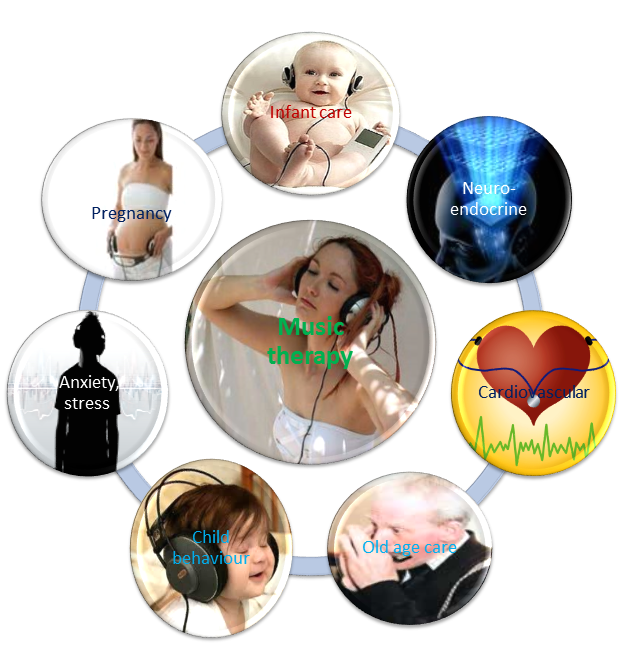
Music has a profound influence on human emotions and well-being. It can elevate mood during moments of happiness and provide comfort during periods of sadness, stress, or anxiety. Through rhythm, melody, and harmony, music stimulates various regions of the brain, helping individuals regulate emotional ups and downs. As a universal form of expression, music promotes emotional balance, relaxation, and deeper connection with one’s inner feelings. Music brings balance to our lives by reducing stress, improving emotional well-being, and creating harmony between the mind and body. It helps us cope with life’s challenges, promotes relaxation, and enhances our overall quality of life.
Music is the universal language of humanity. It transcends cultural, linguistic, and geographical boundaries, connecting people through shared emotions, feelings, and experience. Music as a healing property. Music therapy is also used in the medical line revived after World War 2. After that, scientists’ research increased its benefits (documented by an organisation, the American Music Therapy Association) and were published in a journal of music therapy. Presently music therapy is known to benefit those with mental health needs, Alzheimer’s disease and other ageing-related conditions, substance abuse problems, brain injuries, physical disabilities and labour-related pains. Indian music has been an integral part of Vedic culture since time immemorial. Samveda is full of music, mentioned in Ayurveda to restore Vayu (air), pitta (bile), and kapha (mucus), whose imbalance is considered the root cause of all disease. In India, gurus especially give treatment to the mind through ragas and mantras. However, Raga’s effect and the human mind have a healing property by using the blend of musical notes with specific time periods to achieve intensification and pacification of annotations.
Beethoven – “ Music is the mediator between the spiritual and sensual life.”
Music can change a human’s life, align it and help them to get rid of drugs like smoking and alcohol. Eminent scholar Professor Stillon Judah, professor at Graduate Theological Union Library, Berklee University, noted the extraordinary potential of spiritual music in “turning drug-addicted hippies into devotees of Krishna and servants of mankind”. Music helps in self-confidence, self-doubt, and low confidence levels. The Joint National Committee, USA, in its 7th report listed music as one of the factors that significantly lower stress levels.
Music makes the brain fundamentally quicker and helps as the brain’s healing property. In case of neurobiology of music research, it was discovered that music stimulates specific regions of the brain responsible for memory, motor control, timing and language.
Recent studies presented at a meeting of the Society for Neuroscience in Los Angeles underscore music as an almost universal language of mood, emotion and desire.
“Biology of Music” is said by neurobiologist Mark Jude Tramo of Harvard University Medical School. From enhancing concentration and memory to dealing with diabetics as well as boosting one’s immunity, music therapy lends its healing touch. The passive form of music therapy (listening) has a beneficial effect on all ailments; the active form (participating) is especially helpful for neurological problems.
Dr. Nishindra Kinjalk’s list of some Indian ragas and ailments may benefit patients.
| Disease name | Healing Raga’s |
| Depression | Komal Rishabh Asawari and Shankara |
| Anxiety | Nat Bhairav and Sohini |
| Parkinson’s | Bhatiyar and Yaman |
| Acidity | Bairagi and Bhoopali |
| Hypertension | Todi and Pooriya kalyan |
| Labour pains | Jaunpuri, Hameer and Abhogi |
| Stroke | Ramkali and Gorakh kalyan |
| Asthma | Nilambari, Megh and Bharavi |
Now, from the previous chart, Raag Yaman’s sketchy Aalap is given, which is used to heal Parkinson’s disease.
Note for Indian Notation system
For the lower octave, a dot (.) is placed below the note.
For Middle Octave, “No sign is given in the note.
For a higher octave, a DOT is given to the top of the Note’s
“_” Dash is used for stay in a note
Using capital alphabets for shuddha swara (natural notes) and Using small alphabets, komal/Tivra swar (Sharp notes)
| LOWER OCTAVE | C3 – B3 |
| MIDDLE OCTAVE | C4 – B4 |
| HIGHER OCTAVE | C5 – B5 |
ACCORDING TO AMERICAN STANDARD PITCH NOTATION (ASPN) BY CHELSEY AND BRYN HUGES (WESTERN NOTATION OCTAVE SYSTEM)
“_” Dash is used to stay in a note in the Western notation system
IDENTIFICATION OF SWARA OF INDIAN NOTATION SYSTEM EQUIVALENT TO WESTERN NOTATION SYSTEM
| INDIAN SWARA | WESTERN NOTES |
| SA (S) | C4 |
| RE (R) | D 4 |
| GA (G) | E4 |
| MA (m) – tivra | F#4 |
| PA (P) | G4 |
| DHA (D) | A4 |
| NI (N) | B4 |
Raag Yaman Sketchy Aalap in Hindustani Swara system(Indian style) S-, NRS, NRG-, RGRNRS, NDNDP-, mDN-, DN, mDmNDNRS, GRG-,NDNRG-, RGRS. G-R-, NRG-, NDNRG-, mG-, GRmGP-, mG-, RGR-, NRGmP-, mDP-, mDmPmG-, RGRNRS.
- mDN-, DNDP-, mGMDN-DP, mDmPmG-, RG-, Gm-, mP-, mG-, RGRPmG-, mRGmP-, RG-RS.
- GmDNS, NRS-, NRG-, RGR-, GRNR, N-DP, mGmD, mNDP, mDmP, mRG-, NDNRGR, NRS.
- NRG-, RG-, GRNDNRS, DNRG-, NRNG-, mG, mPmG-, RGRNRS-,
NRSNDNDP, mDNRS.
Now in Western notation system (Raag Yaman) Sketchy Aalap
C4 –, B3 D4 C4, B3 D4 E4 –, D4 E4 D4 B3 D4 C4, B3 A3 B3 A3 G3-, F#3
A3 B3-, A3 B3, F#3 A3 F#3 B3 A3 B3 D4 C4, E4 D4 E4 –, B3 A3 B3 D4 E4 –, D4 E4 D4 C4.
- E4 – D4 –, B3 D4 E4 –, B3 A3 B3 D4 E4 –, F#4 E4 –, E4 D4 F#4 E4 G4 –, F#4 E4 –, D4 E4 D4 C4, B3 D4 E4 F#4 G4 –, F#4 A4 G4 – F#4 A4 F#4 G4 F#4 E4 –, D4 E4 D4 B4 D4 C4.
F#4 A4 B4 –, A4 B4 A4 G4 –, F#4 E4 F#4 A4 B4 – A4 G4, F#4 E4 –, D4 E4 –, E4 F#4 –, F#4 G4 –, F#4 E4 –, D4 E4 D4 G4 F#4 E4 –, F#4 D4 E4 F#4 G4, D4 E4 – D4 C4.
- E4 F#4 A4 B4 C5, B4 D5 C5 –, B4 D5 E5 –, D5 E5 D5 C5, E5 D5 B4 D5, B4 – A4 G4, F#4 E4 F#4 A4, F#4 B4 A4 G4, F#4 A4 F#4 G4, F#4 D4 E4 –, B3 A3 B3 D4, B3 D4 C4.
- B4 D5 E5 –, D5 E5 –, E5 D5 B4 A4 B4 D5 C5, A4 B4 D5 E5 –, A4 B4 D5 E5 –, B4 D5 B4 E5 –, F#5 E5, F#5 G5 F#5 E5 –, D5 E5 D5 B4 D5 C5 –, B4 D5 C5 B4 A4 B4 A4 G4, F#4 A4 B4 D5.
Healing through Indian Classical Ragas:
Indian ragas are based on certain combinations of notes used in a fixed set of ascending and descending order. Occasionally one or two notes may be omitted; the pattern of notes used may be simple or complex. Every raga will have a specific note that is extensively used; this note is referred to as the ‘Vadi Swar’ (sonant note) of that raga. The basic method by which Indian ragas work on the body is simple.
The seven notes are connected to the seven chakras, which influence the organs and the endocrine system. Now, if one has to treat diseases connected to the abdominal area, they can use ragas that have GA (E4 note) as Vadi Swar (Sonat note).
The note GA (E4), pulsating at its specific frequency, will help the organ revert to its original frequency. The balanced organ in turn will gradually bring
back the whole body to its healthy state. Ragas like Yaman, Bhupali, Khamaj & Bihag can be used to treat abdominal disorders
| VADI SWAR
(primary note) |
NAME OF RAGA
(Composition) |
PART OF BODY
|
CHAKRA
(Traditional yogic energy center) |
| SA (C4) | Miyan – ki malhar | Base of spine | Mooladhara |
| RE (D4) | Tilak kamod | Sex organ | Swadhisthan |
| GA (E4) | Yaman, Bhupali,
Khamaj, Bihag |
Abdomen | Manipura
|
| MA (F4) | Durga, Bhairavi, Malkauns, Bageshree | Heart | nahata |
| PA (G4) | Patdeep, Saraswati, Adana | Throat | Visudha |
| DHA (A4) | Alhaiya Bilawal,
Hameer, Sohini |
Between eyebrows | Ajna |
| NI (B4) | Multani | Crown of Head | Sahasrara |
NADA (SOUND) This chart is from the “Nada Bindu Upanishad”; we get the sound and spirituality from this context. Whereas from the “Natyashastra” we get the details of Swaras and Raaga (notes & compositions).
Many diseases can be treated by simply listening to music, but ailments like bronchial problems, sinus, and asthma would require the patient to sing specific ragas or at least certain combinations of notes to enable deep breathing.
The Aumkar music therapy is a part of a discipline called ‘music therapy in Aumkar style’ (it is an Indian style of learning process)
“AUM”
A = kar is empowered to activate the left or lunar channel.
U= Kar has the power to right channel or solar channel
M=kar acts directly or the centre channel.
This therapy is used for stress management.
Effect of music therapy in the stage of adolescents
According to one survey, out of every 100,000 adolescents, two to three thousand suffer from mood disorders, of which 8-10 usually commit suicide. So music can be act as one of the most soothing or nerve-wracking experiences for adolescents as a therapy.
[reference]
American music therapy association (20000 p:26)
The role of music therapy in the treatment of young adults diagnosed with mental illness and substance abuse. Music therapy perspective
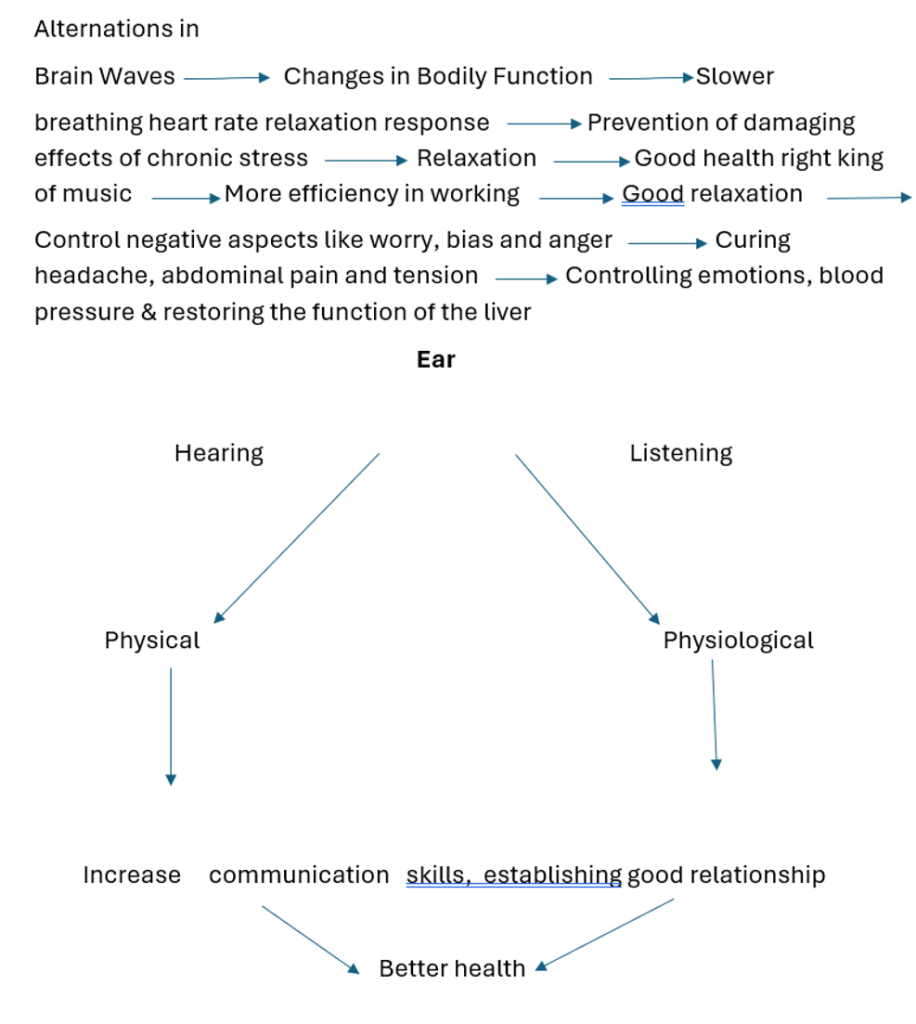
Brain Waves & Music Therapy: It is observed that music with a strong beat can stimulate brain waves to resonate in sync with the beat, with faster beats bringing sharper concentration and more alert thinking, while a slower tempo promotes a calm, meditative state. The change in brainwave activity levels by musical activities can also enable the brain to shift speeds more easily on its own as needed, which means that music brings lasting benefits to your state of mind, even after we have stopped listening.
Conclusion
It is very essential to encourage further research in the field of music therapy. As the side effects are almost negligible, more emphasis must be placed on the implementation of music therapy. Indian music (which is based on melody) should be used more, and musicians should receive training to effectively use their expertise. Therefore, greater emphasis should be placed on research, education and practical implementation of music therapy in healthcare and community settings. Further scientific studies are required to establish its effectiveness across the diverse population. Proper training of musicians and therapists will help ensure the successful application of music therapy for the benefit of society.
Reference
Pranjnyananda swami : A history of Indian music, volume one, Ramkrishna Vedanta math, Kolkata, 1963.
Pranjnyananda swami : A history of Indian music, volume two, Ramkrishna Vedanta math, Kolkata, 1963.
Tagore, S.M: universal history of music, vidya Vilas press Varanasi, 1963.
Ashton.R, (Ed), Music : East and West ( Indian council for cultural Relations, New Delhi, 1966). A comperative study of Indian and Western Music.
Danielou, A, The Ragas of north Indian Music ( Munshi Ram Monoharlal delhi) Notation ( staff) of Hindustani ragas.
Goswami, O., the story of Indian Music (Asia, Bombay, 1957). General.
Sambamoorthy.P., History of Indian music (Indian music publ . HS. , Madras, 1960). Mainly South Indian.
Subha Rao, T.V, studies in Indian Music (Asia,1965). Collected essays on Karnatak Music.
Mrs Mukherjee Rajarshi(Music therapist & Performer) Director, Ma Sharada school of Music. Addis Ababa, East Africa
Srivastava Deepika ( Music therapy for meeting the clue of various physical and mental disorders).
Lakshmi Dwaram ( Seminar on Music Therapy, Music Professor, P.E.S Medical College, 2nd year MEDICO.
*Interviewed with Prof. Nikhilesh Chowdhury, Eminent Musicologist, Former Vice – Chancellor (Officiating), Visva – Bharati and Former Principal, Sangit – Bhavana, Visva – Bharati.