Story and Evolution of Gharanas in Hindustani Music
Bhabani Shankar Dasgupta
Abstract
The Gharana system is the basis of stylistic continuity, oral pedagogy and aesthetic diversification in Hindustani classical music. However, in the post-Tansen period and in the 18th and 19th centuries, the gharana framework was a major emergent force that shifted Indian classical music from formal court patronage into unique stylistic lineages (gayaki and tantrakari). This paper investigates the historical genesis, socio-cultural roots and structural typology of the gharana system. This study examines the genealogical and discipular development of the legendary Senia lineage, the stylistic ramifications of the Dhrupad banis (particularly within the Punjab and Tilmandi traditions), the transition from Dhrupad to Khayal, and the stylistic attributes of foundational schools such as the Delhi, Jaipur-Atrauli, Gwalior, Agra, Patiala, and Kirana gharanas to demonstrate how traditional stylistic guilds maintained structural integrity. In addition, it critically analyses the impact of institutionalised music education of the 20th century on the traditional Guru-Shishya Parampara and discusses the contemporary criticisms regarding orthodoxy and aesthetic survival.
Keywords: Hindustani Classical Music, Gharana System, Senia Lineage, Dhrupad Banis, Khayal Gayaki, Guru-Shishya Parampara, and Pedagogical Musicology.
Conceptual Etymology: Gharana system has played a key role in the preservation, transmission and innovation of musical knowledge in the history of North Indian (Hindustani) classical music. Gharana, from the Hindi and Urdu root word ‘ghar’ (‘house’ or ‘household’), is a socio-artistic institution, a family guild, or a recognised stylistic lineage centred around a master performer and their pedagogical lineage. The literal and cultural meaning of gharana is thus a noble artistic lineage (khandan) whose socio-aesthetic authority is acknowledged across the musical community.
A musician’s association with a gharana is not simply a declaration of biological lineage; it is a mark of intense tutelage under a guru, a commitment to a particular aesthetic and a meaningful historical input to the living art. There were precursor institutional structures before the mediaeval period in the form of regional classifications, sampradayas (traditions) or banis (stylistic modes of execution), but the gharana system, as an organised socio-pedagogical institution, bloomed primarily in the post-Tansen era. The framework encompasses vocal music (like Dhrupad, Khayal and Thumri), instrumental traditions (tantrakari for Sitar, Sarod and Veena; tabla lineages) and classical dance forms like Kathak.
As musicologist Daniel M. Neuman notes regarding the social organisation of North Indian classical music:
“A gharana is not merely a stylistic school; it is a whole system of training, aesthetic values and stylistic lineage that connects ancestral knowledge with the creative individual interpretation in an oral tradition.” (Neuman, 1990, p. 96)
Traditionally, musicologists accept an ideology or lineage as a gharana only when its unique stylistic identity (gayaki or baaj) is transmitted and maintained through at least three successive generations of master musicians, either by hereditary descent (khandani) or through the non-filial Guru-Shishya Parampara.
Typology and Nomenclature of Musical Lineages
A detailed study of Indian musical history indicates that gharanas have traditionally obtained their designations through three major conventions:
Geographical Names
Gharanas often took the name of the city, princely state or region from which the founding maestros hailed or received royal patronage. The prominent ones include the Gwalior, Agra, Delhi, Jaipur, Kirana and Patiala gharanas. The local style became synonymous with the place itself. Classical music was pursued in these urban or courtly centers with more intensity and royal support.
A number of gharanas derived their names directly from an eminent founding maestro, patriarch or ancestral clan. The Senia gharana (named after Miyan Tansen), the Imdadkhani or Etawah gharana (named after Ustad Imdad Khan), and the Kawal or Qawwal Bachchon gharana are classic examples of lineages defined by a central patriarchal figure.
Family dynasties
Some schools were identified with particular musical families (khandans), which produced successive generations of outstanding performers. In these lineages, musical repertoire, secret vocal techniques (bhed) and proprietary compositions (bandishes) were kept as closely guarded familial intellectual property.
Post-Tansen Period and the Senia Tradition
Hindustani classical music was significantly restructured after the tenure of Miyan Tansen, the main court musician of Emperor Akbar in the 16th century. During this period, the serious, highly structured and spiritual style of Dhrupad singing was the leading classical vocal style in the main musical centers of Delhi, Gwalior, Punjab and Rewa.
The legendary Senia gharana, which traces its lineage directly to Tansen, is the source of almost all the major subsequent lineages of Hindustani vocal and instrumental music. The Senia lineage split into three different branches over a period of time.
Familial Vocal Lineage (Direct Male Line): Downwards through Tansen’s son Bilas Khan (composer of Raga Bilaskhani Todi) and his descendants who specialised in the vocal presentation of Dhrupad and Dhamar.
The Instrumental Lineage (Matrilineal Line): This lineage developed through Tansen’s daughter, Saraswati Devi, and her husband, the legendary Beenkar (Veena maestro) Misri Singh (later known as Nabat Khan). This branch was the seed of North Indian instrumental traditions and produced the famous Beenkar, Rababiya and Sitar gharana .
The Discipular Lineage (Shishya Parampara ):) includes Tansen’s non-filial disciples (shishyas) and his direct students, as well as their descendants who propagated the Senia gayaki and compositional repertoire in different regional royal courts.
Regional Ramifications Punjab and the Dhrupad Banis
In addition to the Senia lineage, the northwestern region of Punjab was a centre of musical activity that contributed significantly to the development of vocal and instrumental styles. Traditionally, Dhrupad singing was divided into four distinct stylistic modes or ‘banis’ (from the Sanskrit ‘Vani’, meaning ‘voice’ or ‘speech’):
Gauhar (or Gobarhar) Bani (related to melody and smooth transitions)
Dagur Bani (characterised by pure note intonation and reflective, slow alaps)
Khandar Bani (with vigorous, forceful movements and rhythmic strength)
Nawhar or Nauhar Bani (noted for rapid, leaping passages and elaborate note permutations)
These banns had several distinct ramifications for the Punjab regional tradition:
Tilmandi Gharana: Maestros Chand Khan and Suraj Khan were part of the Tilmandi line and integrated stylistic principles of the Khandar and Nawhar Banis.
Dagur Bani Exponents: Another important stream in Punjab was home to renowned singers, including Brij Chand and Sri Chand, who promoted the Dagur Bani style.
Further Regional Developments: Sri Chand established a localised school, and Sujan Khan set up a parallel branch dedicated exclusively to the preservation of the Nawhar Bani tradition.
These stylistic divisions indicate that long before Khayal became the dominant vocal style, regional Dhrupad guilds had systematic methods of vocal ornamentation, breath control, and rhythmic navigation.
Dhrupad’s Transition to Khayal and the Emergence of Prominent Gharanas
The emergence of Khayal Vocalism
In the 17th century, Dhrupad was still the music of choice in royal courts. However, the genre of Khayal (an Arabic word meaning ‘imagination’ or ‘thought’) was developing and being refined. The singers of the Delhi Gharana, known as the Kawal or Qawwal Bachchon Ka Gharana, pursued early Khayal vocalism. This guild, founded in the 13th century by the direct disciples of the Sufi poet-musician Hazrat Amir Khusrau, encouraged early, romanticised vocalisations that featured lyrical freedom, flexibility, and melodic embellishment.
By the mid-18th century, court musicians Niamat Khan (popularly known as Sadarang) and his nephew Firoz Khan (Adarang) systematically restructured Khayal under the patronage of Mughal Emperor Muhammad Shah “Rangila”. They created hundreds of classic bandishes (compositions) that married the structural weight of Dhrupad with the imaginative freedom of Khayal.
With the weakening of the late Mughal Empire and the rise of British colonial expansion, political stability in Delhi declined and court musicians migrated to provincial princely states like Gwalior, Agra, Lucknow, Jaipur, Rampur and Hyderabad. This geographical spread paved the way for the emergence of the major Khayal gharanas of the 18th and 19th centuries.
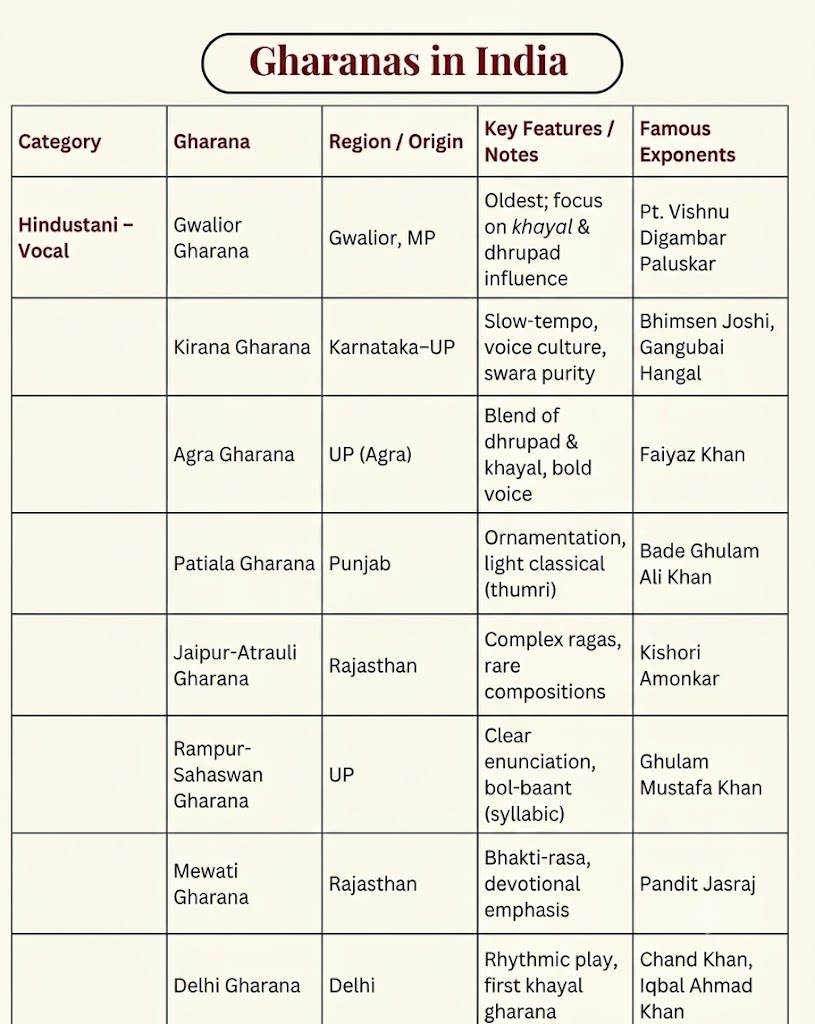
Structural and stylistic characteristics of the major Khayal gharanas.
Delhi Gharana
Root Patriarch: Ustad Tanras Khan (Mir Qutub Bakhsh), court musician to the last Mughal Emperor, Bahadur Shah Zafar.
Key exponents: Umrao Khan (son of Tanras Khan), Ustad Chand Khan (uncle of Ustad Nasir Ahmed Khan), and Ustad Iqbal Ahmed Khan. Stylistic Characteristics: Known for vocal agility, elaborate tan-bazi (rapid melodic runs), crisp articulation and metrical beauty. Tanras Khan’s name (Tan-ras, “juicy/masterly tans”) derived from his command of rapid, varied tan patterns. The Delhi style also provided a pedagogical base for artists from other regions. For instance, the Patiala gharana was founded by Ali Bux and Fateh Ali Khan (lovingly called “Aloo-Fattu”) who were trained in vocals under Tanras Khan.
Jaipur-Atrauli Gharana
Rooted in its early history in Manarang (son of Shah Sadarang) and reformed into its present shape by Ustad Alladiya Khan in the late 19th century.
Key Exponents: Ustad Mohammad Ali Khan (popularly known as Kothewale for his storehouse of rare classical compositions), Kesarbai Kerkar, Mogubai Kurdikar, Mallikarjun Mansur, Kishori Amonkar.Stylistic Characteristics: Marked by complex, intricate tans, dense and sonorous voice production, subtle rhythmic layakari and emphasis on rare (jod and achhop) Ragas. The lyrics and bandishes of this style are short, structurally balanced and precise.

Gharana Tree | Agra Gharana
Gwalior Gharana
Early Patriarchs: Nathan Pir Bakhsh, Hassu Khan, Haddu Khan, Nathu Khan.
Notable Proponents: Krishnarao Shankar Pandit, Raja Bhaiya Poonchwale, Vishnu Digambar
Paluskar, Kumar Gandharva.
Stylistic Features: It is the “mother gharana” of Khayal singing due to its fundamental place. It has a well-balanced, lucid presentation of Ragas with a direct, open-throated voice culture (aakar). A standard Gwalior performance has a well-defined three-stage development (Asthai-Antara exposition, slow alap-behlava, followed by organised bol-tans and fast tans).
Agra Gharana
Foundational Patriarchs: Has its historical lineage traced to Sujan Khan (pioneer of Nauhar Bani), later transformed into a Khayal lineage by Ustad Faiyaz Khan.
Key Exponents: Ustad Faiyaz Khan, Ustad Vilayat Hussain Khan, Pandit S. N. Ratanjankar.
Stylistic Characteristics: Combines the weight, gravity and nom-tom alap of the Dhrupad tradition with the responsive melodic style of Khayal. Bol-banthan, resonance in the chest voice, rhythmic playfulness (layakari) and emotive delivery (pukar) are of great importance.
Kirana Gharana
Founding Patriarchs: Ustad Abdul Karim Khan and Ustad Waheed Khan (named after the town of Kirana in Uttar Pradesh)
Major Exponents: Pandit Bhimsen Joshi, Gangubai Hangal, Sawai Gandharva, Prabha Atre.
Stylistic Traits: Focus on note intonation (swara-shuddhi), emotional intensity and slow, meditative Raga development (badhat) note by note. The Kirana style is characterised by a focus on tonal purity and melodic continuity rather than quick rhythmic changes.

Kirana gharana – Wikipedia
Patiala Gharana
Foundational Patriarchs: Ustad Ali Bux Khan and Ustad Fateh Ali Khan (Aloo-Fattu).
Major Representatives: Ustad Bade Ghulam Ali Khan, Ustad Amanat Ali Khan, Pandit Ajoy Chakrabarty
Stylistic Characteristics: Characterised by emotive expression, vocal agility, elaborate ornamentation (murki, khatka, kan-swara) and fast, intricate tans. It successfully merges the heavy classical Khayal with semi-classical forms such as Thumri and Dadra.
Socio-Pedagogical Dynamics and Contemporary Challenges.
Institutionalisation of Music Education
In the late 19th and early 20th centuries, musical pioneers Pandit V. N. Bhatkhande and Pandit V. D. Paluskar, in an effort to democratise the learning of classical music, established institutional music colleges (such as Gandharva Mahavidyalaya and Marris College of Music, now Bhatkhande Music University). They formalised music writing systems, collected classical works into textbooks, and created organised syllabi.
This change in institution has led to more access to classical music beyond closed hereditary families but has also changed the traditional Guru-Shishya Parampara.
Contemporary Challenges and Critiques
The advent of short-term institutional diplomas, digital media, online classes, and the pressures of commercial performance have stirred debates about the present state of gharanas. Critics and contemporary musicologists have noted several ongoing problems:
Eclecticism vs. Stylistic Purity: Modern performers often blend elements from multiple gharanas (for example, combining the note-by-note exposition of Kirana with the rapid tans of Patiala), leading some scholars to describe a style that is “eclectic” or “generic” Hindustani vocal style.
Superficial Pedagogy: Standardised curricula generally emphasise examination syllabi more than the slow cumulative process of voice cultivation (aazadi and riyaz) characteristic of traditional lineages.
Misconceptions of Orthodoxy:
Some of the contemporary critics see gharanas as rigid, or archaic institutions. But historical evidence shows that the founder of a major gharana was a man of innovation, who adapted existing traditional forms to create new artistic expressions.
As V. H. Deshpande observed in his aesthetic study of Hindustani gharanas:
“A gharana is not a rigid prison of rules but a living, organic framework of artistic discipline. True masters do not simply copy their ancestors; they use the gharana’s core discipline as a launchpad for their personal creative expression.” (Deshpande, 1989, p. 42)
The gharana system remains an important institution in the history, pedagogy and aesthetics of Hindustani classical music. The gharana model, from its post-Tansen origins to the ramification of the Senia lineage, the specialisation of Dhrupad banis, and the flourish of Khayal gayaki, offered a systematic framework for the preservation of artistic knowledge.
Although the way music is taught and received has been changed by modern technology, institutional universities and shifting models of patronage, the major gharanas continue to exert an influence on performance practices through their core aesthetic principles. Far from being an antiquated or unfounded institution, the gharana system is a living tradition, providing the structural framework and aesthetic discipline that allows individual artists to innovate, while maintaining continuity with India’s classical tradition.
Notes
Gharana: etymology and social context: The term gharana is etymologically derived from ghar (house/household). In the past, it referred to family guilds with exclusive rights to proprietary musical compositions (bandishes) and to vocal techniques (bhed).
The Four Banis of Dhrupad: Traditional Dhrupad singing was categorised into four main stylistic branches (Banis): Gauhar, Dagur, Khandar and Nawhar. These laid the base of vocal execution in the later Khayal gharanas.
Senia Lineage Ramifications: Named after Miyan Tansen The lineage divided into vocalists (through Tansen’s son Bilas Khan) and instrumentalists (through Tansen’s daughter Saraswati Devi and son-in-law Misri Singh).
Qawwal Bachchon Ka Gharana: Established in Delhi by followers of the Sufi poet-musician Hazrat Amir Khusrau during the 13th–14th centuries. This family was instrumental in early Khayal development. Ustad Tanras Khan: The title of “Tanras Khan” was given to Mir Qutub Bakhsh by the Mughal Emperor Bahadur Shah Zafar for his excellent command over fast vocal runs (tans). How the title ‘Kothewale’ originated: Ustad Mohammad Ali Khan of the Jaipur gharana was called Kothewale (literally meaning attic/storehouse) in acknowledgement of his mind’s storehouse of rare classical compositions.
Institutional Pioneers: Pandit V. N. Bhatkhande and Pandit V. D. Paluskar led the movement to establish formal music colleges in the early 20th century, setting a standard for music education in India.
HINDUSTANI CLASSICAL MUSIC: GHARANA OVERVIEW
Major Khayal & Instrumental Gharanas at a Glance
| Gharana | Foundational Patriarch(s) | Key Exponents | Core Aesthetic & Stylistic Characteristics |
| Delhi | Ustad Tanras Khan (Mir Qutub Bakhsh) | Umrao Khan, Ustad Chand Khan, Ustad Iqbal Ahmed Khan | Intricate tan-bazi (rapid vocal runs), high metrical precision, clear vocal articulation, and rhythmic agility. |
| Gwalior | Nathan Pir Bakhsh, Hassu Khan, Haddu Khan | Krishnarao Shankar Pandit, Raja Bhaiya Poonchwale, V. D. Paluskar | Known as the “Mother Gharana” of Khayal; open-throated singing (aakar), structured Asthai-Antara presentation, and balanced bol-tans. |
| Jaipur-Atrauli | Shah Sadarang / Manarang, Ustad Alladiya Khan | Kesarbai Kerkar, Mogubai Kurdikar, Mallikarjun Mansur, Kishori Amonkar | Complex tans, dense sonorous tone, subtle rhythmic layakari, and mastery over rare (jod / achhop) Ragas. |
| Agra | Sujan Khan (Nauhar Bani), Ustad Faiyaz Khan | Ustad Vilayat Hussain Khan, Pandit S. N. Ratanjankar, Latafat Hussain Khan | Synthesis of Dhrupad weight with Khayal; features nom-tom alap, chest resonance, bol-banthan, and emotive pukar. |
| Kirana | Ustad Abdul Karim Khan, Ustad Waheed Khan | Sawai Gandharva, Pandit Bhimsen Joshi, Gangubai Hangal, Prabha Atre | Focuses on note intonation (swara-shuddhi), highly emotional delivery, and slow, meditative badhat (note-by-note progression). |
| Patiala | Ustad Ali Bux Khan, Ustad Fateh Ali Khan (“Aloo-Fattu”) | Ustad Bade Ghulam Ali Khan, Ustad Amanat Ali Khan, Pandit Ajoy Chakrabarty | Highly expressive, vocal agility, delicate ornamentation (murki, khatka), swift tans, and seamless bridge to semi-classical Thumri. |
| Senia | Miyan Tansen | Bilas Khan, Saraswati Devi, Misri Singh (Nabat Khan), Wazir Khan | The primary root of North Indian classical traditions; split into direct vocal lineages and instrumental (Beenkar / Rababiya) lineages. |
| Imdadkhani (Etawah) | Ustad Imdad Khan | Ustad Inayat Khan, Ustad Vilayat Khan, Ustad Shahid Parvez | Instrumental Sitar/Surbahar tradition; famous for introducing vocal gayaki ang to instrumental playing, fast jhala, and fluid meend. |
Key Dhrupad Banis & Regional Lineages
| Dhrupad Bani / Regional Lineage | Historical Origin | Key Associated Gharanas / Style |
| Gauhar (Gobarhar) Bani | Tansen / Gwalior Court | Emphasizes smooth melodic flow, purity of Raga structure, and serene transitions. |
| Dagur Bani | Swami Haridas / Dagur Lineage | Pure note intonation, slow contemplative alap, maintained by the Dagar family tradition. |
| Khandar Bani | Raja Samokhan Singh / Misri Singh | Robust, energetic, and forceful note movements with strong rhythmic emphasis. |
| Nawhar Bani | Sri Chand / Sujan Khan | Characterized by rapid, leaping note movements, unexpected turns, and intricate phrasing. |
| Tilmandi Gharana | Chand Khan & Suraj Khan (Punjab) | Fused stylistic nuances of both Khandar and Nawhar Banis within northwestern traditions. |
References
- Bhatkhande, V. N. (1990). A comparative study of some of the leading music systems of the 15th, 16th, 17th, and 18th centuries. Sangeet Natak Akademi.
- Deshpande, V. H. (1989). Indian musical traditions: An aesthetic study of gharanas in Hindustani music (2nd ed.). Popular Prakashan.
- Misra, S. (1990). Great masters of Hindustani music. Publications Division, Ministry of Information and Broadcasting, Government of India.
- Neuman, D. M. (1990). The life of music in North India: The organization of an artistic tradition. University of Chicago Press.
- Ranade, A. D. (1984). On music and musicians of Hindoostan. Promilla & Co.
- Roychoudhury, V. U. (1999). Senia Gharana and its contribution to Indian classical music. Reliance Publishing House.
- Wade, B. C. (1984). Khyal: Creativity within North India’s classical vocal tradition. Cambridge University Press.