The Subaltern Heroine: A Feminist Critique of Kalidasa’s Shakuntala
Soma Mondal, Assistant Professor, Department of English, Gobardanga Hindu College
Abstract
The present article is an attempt to study the depiction of women in classical Sanskrit literature with particular reference to the character of Shakuntala in Kalidasa’s magnum opus, Abhijnana Shakuntalam. It deals with the role of the traditional ‘golden rule’ of feminine virtues, such as compassion, patience, faithfulness and submissiveness, in a deeply entrenched patriarchal background. This paper studies the subjection of female identity in classical epics through Western and third-world feminist theories, such as those of Gayatri Chakravorty Spivak, Patricia Hill Collins, and bell hooks. It explores the dualities of Shakuntala’s character: her subaltern identity as a woman under male hegemony, her resistance and self-realisation and her acquiescence to patriarchal restoration. In sum, the article shows how classical literary narratives have historically traded female autonomy for the preservation of cultural and familial codes but also observes the growing modern reinterpretations that present Shakuntala as a symbol of resilience and dawning empowerment.
Keywords: Sanskrit Literature, Kalidasa, Shakuntala, Feminism, Patriarchy, Subaltern, Male Hegemony, Empowerment.
Introduction: Women and the ‘Golden Rule’ in Classical Literature
A major theme running through the epics, poems and dramas of classical Sanskrit literature is the portrayal of women. Throughout history, writers, poets and critics have described feminine identities in various shades and colours to suit the changing tastes and moral strictures of contemporary society. This way, they consciously present the cultural ethos through the voices of their characters. Literature has served as a mirror reflecting societal attitudes and responsiveness towards the feminine gender, from classical authors like Rishi Vyas and Kalidas to modern writers such as Jhumpa Lahiri, Bharathi Mukherjee, Shobha De, and Arundhati Roy.
Classical narratives portray female protagonists as having traits that are generalised in their depiction: compassion, generosity, persistence, patience, faithfulness and an unyielding loyalty to the domestic sphere. Such traits often become romanticised into the “golden rule” of womanhood. But a close reading, however, reveals that authors like Kalidasa often wrote their works to cater to the specific ideological needs of elite, male-dominated audiences, suggesting a clear absence of narrative innocence. Where a woman is placed in any literary text, it is an indication of the degree of patriarchy in society at that particular time. A woman’s identity is closely linked with culture and its representation. When a woman’s portrayal changes in literature, it can be considered a change in culture as a whole.
Theoretical framework: The development of feminisms and feminist literary theory
To deconstruct these classical representations, it is necessary to place the analysis in the history of feminist thought. The word ‘feminism’ has a long history in the English language, from women’s crusades in the late nineteenth century to the present day. Feminism generally emphasises how male-dominated social structures systematically subordinate women. Feminist activists and theorists argue that patriarchal structures systematically deprive women of autonomy, equality, and independent decision-making, reducing them to substandard dependents. When a woman tries to exercise her agency or her power of speech, her voice is often silenced or reframed as a breach of social convention.
In patriarchal cultures, women bear a special burden as the keepers, carriers and defenders of culture, tradition and family honour. These rigid codes of ethics routinely sacrifice a woman’s personal predispositions, desires, and eccentricities. As bell hooks (2000) reminds us, feminism is not a static concept but is always in flux, shaped by the intersectional ways we view the world and ourselves.
Feminist literary criticism, when applied to texts, serves as an analytical tool for exposing and rejecting the patriarchal norms that privilege masculine worldviews while marginalising women politically, economically, and psychologically (Awad, 2017). Although modern feminist criticism gained much institutional momentum within the post-World War II movement in American universities, its roots extend back to Mary Wollstonecraft’s A Vindication of the Rights of Woman (1792) and further to the seminal interventions of John Stuart Mill, Margaret Fuller and Simone de Beauvoir.
The Divine Object: Beauty, Desire and the Gaze in Abhijnana Shakuntalam
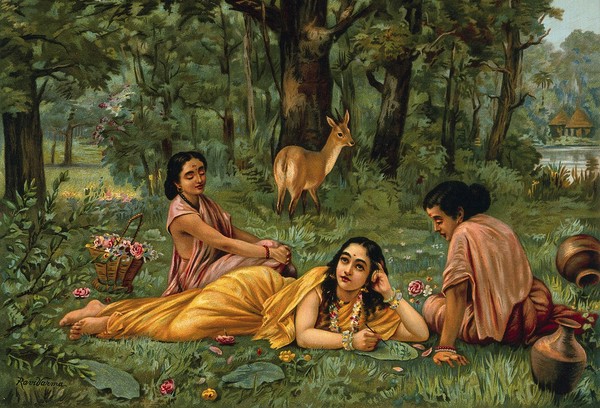
Kalidasa in Abhijnana Shakuntalam describes Shakuntala as a maiden of matchless physical beauty descended from her celestial mother nymph Menaka. From the moment he sees her in the sacred grove, King Dushyanta is completely captivated by her. Her beauty is so divine that he cannot help but succumb to his desires. His admiration is reflected in:
KING: That’s the way it should be. Such beauty cannot be born of women, nor the quivering flash of lightning be earth’s own child. (Act I, p. 13)
Kalidasa depicts Shakuntala as a dutiful daughter and as the one who is conscious of social exclusions. She loves her family of hermitage and protects the integrity of her foster father. But when, in her absence from her parents, she is caught by mutual lust, she consents to a Gandharva marriage (a marriage by mutual consent without any formal rites) with Dushyanta.
Her behaviour in this romance still follows the patriarchal expectations of the idealised, shy Indian woman. She wants to be near the king but hides her feelings and can’t look him in the eye. Dushyanta observes this submissively attractive modesty:
King: She hears me speak, yet will not speak to me. / Her eyes turn not to see my face, yet nothing else they seek. (Act I, p. 15)
Subalternity and the disintegration of female autonomy
Shakuntala’s journey is a reflection of the subaltern condition of women in male-dominated societies. As Gayatri Chakravorty Spivak (2010) writes, women in India have been historically relegated to the position of the subaltern, to spaces where political and social speech is structurally constrained. Spivak (p. 52) notes that even the venerated goddesses of Hindu tradition are often portrayed in stories that justify the containment of common women and that institutional structures often frame women as objects requiring protection “from her kind” (p. 52).
This system has been instrumentalised by the very conditions of Shakuntala’s birth. Her mother Menaka was sent by the gods as a seductress to interrupt the strict penance of the sage Vishwamitra. When the divine purpose was served, Menaka had to leave her infant behind and return to heaven. Orphaned by maternal care, Shakuntala is raised by her adoptive father, the sage Kanva, in a lonely forest hermitage.
In the farewell advice to Shakuntala on her way to Dushyanta’s palace, Kanva spells out in so many words the rules of female submission and the sacrifice of individual freedom necessary to be a perfect wife:
Kanva: Obey your elders, and be very kind / To rivals; never be perversely blind / And angry with your husband, though he / Should prove less faithful than a man may be; / Be as courteous to servants as you can, / Not puffed with pride in this your happy span: / Thus does a maiden grow into a wife. / But self-willed women are the curse of life. (Act IV, p. 49).
This speech underscores the hegemonic idea of pativrata, a cultural model that prescribes a wife’s unquestioning devotion to her husband and family as her highest religious duty (Thakur, 2012). Spivak (1996) questions this unqualified surrender by questioning why the “husband” routinely becomes the definitive marker of a woman’s entire existence, forcing the equation that “to be” is inherently “to be a wife” (p. 248). In this paradigm, the woman’s purity and fidelity are continually called into question, whereas the man’s promiscuity or frivolity is not.
Repudiation, Resistance and the Rise of Self-Esteem
The central crisis of the play is at the court of Hastinapur. The king denies paternity of his unborn child, forgetting everything about his marriage and his wife Shakuntala, because he has incurred the curse of the sage Durvasa, who was angry because Shakuntala, love-lorn and distracted, did not take care of Dushyanta’s signet ring. This is a very poignant moment of vulnerability, as Monona Wali notes, for the king denies legitimacy to Shakuntala by refusing to acknowledge their union in a society that is extremely rigid and unforgiving.
When Dushyanta insults her, accusing her of exploiting the ‘intuitive cunning of womanhood’, Shakuntala’s performance of the submissive protagonist shatters. When faced with total depreciation, her self-respect and her indignation take over. She snaps back viciously:
Shakuntala: You villain! You measure all this by your false heart. Would any other man have done what you have done? To cover up behind virtue, as a yawning well is covered up with grass! (Act V, p. 58)
Dushyanta visibly reacts to this assertion of independence, remarking that her anger appears quite genuine. But the court refuses her altogether, and not even her hermitage companions Sharngarava and Gautami will take her back, telling her to bear her husband’s contempt if her vow is pure (Act V, p. 60).
Shakuntala is left entirely unprotected but is rescued by a divine light (her mother Menaka in disguise) and taken to the heavenly hermitage of the sage Kashyapa. Dushyanta’s denial is structurally parallel to that of King Rama to Sita in the Ramayana. In both stories, the virtuous female archetype is sacrificed to satisfy external socio-political metrics of honour, reiterating a systemic pattern of marginalising the physical and emotional struggles of women to the periphery of the grand narrative (Paul et al., 2022).
Maternal Marginalisation and the Reinstatement of Patriarchal Hegemony
Shakuntala has to go through a strenuous journey of single motherhood in the celestial asylum and brings up her son Sarvadamana. However, in Kalidasa’s story, women have little opportunity for self-actualisation beyond male lineage. On seeing the boy taming a lion cub, Dushyanta, who has regained his memory with the recovered ring, recognises his own reflection at once. He compliments the boy’s natural courage and strength:
King: Why should I care about this boy as if he were my son? […] The boy is a seed of flame. (Act VII, p. 85).
This focus on the child’s masculine aura legitimises the father’s bloodline, while it erases Shakuntala’s years of solitary labour and trauma. Patriarchal laws and traditions have been used to control reproduction and to claim the offspring’s lineage, thereby enforcing the subordination of women (Catharine MacKinnon, 2006). Even when confronted by the boy’s mother, Dushyanta’s deep-rooted suspicion does not leave him, as he wonders about her identity. This shows that the patriarchal doubts that he harboured years ago are still stubbornly in place.
When Shakuntala first sees Dushyanta, she cannot recognise him through her trauma: “It is not my husband. “Who is the man that soils my boy with his embraces? ” (Act VII, p. 88). But she has had enough, and when he asks her to forgive him, her pent-up feelings burst forth at once, and she forgives him serenely, without a complaint. Contemporary readings, like those of Utkarsh (2024), seek to equate Shakuntala with the modern woman – independent, assertive, courageous, and demanding respect. But the structural resolution of the play securely drives her back into the domestic custody of the traditional, perfect Indian wife.
Women’s Empowerment and Contemporary Epistemologies
Ultimately Kalidasa creates a very nuanced text where neglect of duty is systematically punished and cultural ideals are maintained. In contemporary sociology, globalisation, educational opportunities and economic modernisation are considered major social changes that have contributed to the fact that women have been able to openly challenge patriarchal dominance.
As Patricia Hill Collins (2000) argues, historically colonised or structurally subjugated people develop a very complex “outsider-within” perspective, learning the dominant culture in great detail in order to develop crucial coping and survival skills.
It is this very inner strength that Shakuntala survives her psychological and social exile with. Though the classical framework of Kalidasa ultimately confines her within the limits of traditional wifehood, an integrated feminist reading reveals her underlying empowerment. Her positive self-image, her fundamental dignity and her ability to survive in a violently oppressive environment prove that even within the strict boundaries of classical Sanskrit drama the voice of female resilience could never be totally silenced.
Bibliography
- Awad, P. (2017). Introduction to Literary Theory and Criticism. Assumption College Publications.
- Collins, P. H. (2000). Black Feminist Thought: Knowledge, Consciousness, and the Politics of Empowerment. Routledge.
- Hooks, b. (2000). Feminism is for Everybody: Passionate Politics. South End Press.
- Kalidas. (1999). Abhijnana Shakuntalam (M. R. Kale, Trans.). Motilal Banarsidass Publishers. (Original work published c. 4th-5th Century CE).
- Khanal, S. (2021). Etymological definitions and feminine representation in classical Sanskrit aesthetics. Journal of South Asian Literary Studies, 14(2), 85-98.
- MacKinnon, C. A. (2006). Are Women Human?: And Other International Dialogues. Harvard University Press.
- Narayan, V. (2008). Gender Inequality and Family Law Reform in India. Civil Society and Law Review.
- Paul, A., Sen, M., & Das, S. (2022). Epics of Absence: Comparing the Repudiation of Sita and Shakuntala in Classical Indian Narratives. Indian Journal of Gender Studies, 29(1), 5-19.
- Spivak, G. C. (1996). The Spivak Reader: Selected Works of Gayatri Chakravorty Spivak (D. Landry & G. MacLean, Eds.). Routledge.
- Spivak, G. C. (2010). Can the Subaltern Speak? In R. Morris (Ed.), Reflections on the History of an Idea (pp. 21-78). Columbia University Press.
- Thakur, H. (2012). The Pativrata Paradigm: Domesticity and Duty in Classical Hindu Literature. Journal of Religion and Culture, 38(4), 455-470.
- Tiwari, R. (2011). Mythological Shelters: Women’s Spaces in Sanskrit Drama. Heritage Publishers.
- Utkarsh, K. (2024). The Modern Shakuntala: Assertiveness, Equality, and Resilience in Classical Paradigms. Academic Press.